Pages

Showing posts with label NT: Gospel of Mark. Show all posts

Monday, November 19, 2012

Homily for Pentecost 25


Tell us, when will this be, and what will be the sign that all these things are about to be accomplished? 


Israel assassinates the military commander of Hamas.
The Palestinians send bombs into Tel Aviv and then Jerusalem.
Over 150 Palestinians are killed by Israeli attacks on Hamas targets.
Israel calls up 70000 reservists ready for a ground assault on Gaza.

That same day there are mass strikes and protests in Europe.
Workers and union leaders call for everyone to stop work in protest of new austerity measures.
Police and the army arrest 100s in Portugal, Spain, and Greece.
In Spain unemployment has reached 25 %.

In these same days, there is a solar eclipse.
The sky is darkened, and the sun gives of no light,
other than a bright haunting ring that blinds those who dare look at it.

Earlier in the month there is a hurricane in the east coast of the US and Cuba.
Hundreds die, hundreds of thousands are left homeless.
Those with homes have no power.
Looting takes place, there is no food in the shops, there is lawlessness.
People are scared and hungry.


When you hear of wars and rumours of wars, do not be alarmed;
this must take place, but the end is still to come. 
For nation will rise against nation, and kingdom against kingdom; 

Some see our time as the end times.

Some seem to gain much comfort from the fact that the period they are living in God has chosen to be the final stage of humanity.
This is where Christ will return, and all the redeemed of the earth will be raptured.
Many take comfort from the fact that those who disagree with such ideas willing fact be left behind.

These ideas started way before Jesus, as we heard from the book of Daniel earlier:

At that time Michael,
the great prince,
the protector of your people,
shall arise.
There shall be a time of anguish,
such as has never occurred since nations first came into existence.

In Daniel’s understanding, the archangel Michael will rise and protect the people of Israel.

Jesus doesn’t really talk about the end times. He talks about some things that must happen before the end times can occur.

When you hear of wars and rumours of wars, do not be alarmed;
this must take place, but the end is still to come.
For nation will rise against nation, and kingdom against kingdom; 

Since Jesus time, there has rarely been a time of peace. There have been periods where there has been less conflict, or conflict on a smaller scale, but always some conflict. Our own time is one of the worst for international war.

This is but the beginning of the birth pangs. 

The disciples ask when the end times will occur.
Jesus answers later:

But about that day or hour no one knows,
neither the angels in heaven, nor the Son,
but only the Father. 

Not even Archangel Michael, who Daniel informs us, will be the precursor knows when these things are to occur.

The conflict in Gaza and Israel, the strikes and economic woes of Europe, the hurricane in the US and the solar eclipse aren’t signs of the end times. Jesus warned against predicting such things. He in fact taught the opposite:

do not worry about tomorrow, for tomorrow will bring worries of its own.
Today's trouble is enough for today. 

Be present to what is happening.
Being present and like Christ is being aware, being ready to help, noticing and acting upon injustice and suffering.

The way of Christ is to renounce all violence in the Israel and Gaza, not to take sides, to unmask the cause of the violence.  It is to make sure those who are injured are healed and those who are hungry are fed.

The way of Christ is to fed, clothe and home those who have suffered through the hurricane.

It is natural to worry about the future.
We all want to know what is going to happen.
But Jesus reminds us to be present to where and when we are:

do not worry about tomorrow, for tomorrow will bring worries of its own.
Today's trouble is enough for today. 

Look at what is happening around us, not in some way to predict the future, but to be truly present to what is actually happening. Be present like Christ was present to the suffering he witnessed

It is by being present to what is occurring that we can be like Christ: helping, healing, teaching, showing the light and love of God to all we meet.

Instead of trying to work out when the end is to happen, Jesus tells us to present to the suffering and anguish that is around us, in our present time.

Do not worry about tomorrow, for tomorrow will bring worries of its own.
Today's trouble is enough for today. 

But about that day or hour no one knows,
neither the angels in heaven, nor the Son,
but only the Father. 


Sunday, October 7, 2012

Homily for Pentecost 19


Whoever does not receive the kingdom of God as a little child will never enter it.

The importance of children in Jesus mission and teaching is clear and once again, we find children in the presence of Jesus.

Whoever welcomes one such child in my name welcomes me, and whoever welcomes me welcomes not me but the one who sent me
If any of you put a stumbling block before one of these little ones who believe in me, it would be better for you if a great millstone were hung around your neck and you were thrown into the sea. 

Let the little children come to me; Do not stop them; for it is to such as these that the kingdom of God belongs


In these three examples, Jesus is stressing the importance of children in the life of the kingdom.

We aren’t to be stumbling blocks for them.
We are to welcome them. By welcoming children, we welcome Christ himself.

It is to such as these that the Kingdom of God belongs.

Such as these. People like these. Brothers and sisters whose hearts are like that of a child.

Jesus isn’t saying that the Kingdom of God belongs to children.

It doesn’t. It belongs to all who believe, and of course that will include children, but not children exclusively.


“Whoever does not receive the kingdom of God as a little child will never enter it.”

And here we reach the reason why children are important for Jesus.


Yes, they are important in themselves,
as people,
as a fellow brother or sister in Christ,
they are of equal standing with anyone else.

The church belongs as much to children as it does to priests or wardens or organists or any of us.

The church works at its truest when it understands this.
The church is at its best when it is what it needs to be for
an infant,
a  9 year old,
a teenager,
a young mum,
a father of two,
a grandfather of 8,
or a great grandmother of 32.

The church belongs to all these, equally.
No one’s needs are more important than the other.
They are different needs, but of equal significance.

But Jesus uses the idea of children in a deeper way.

“Whoever does not receive the kingdom of God as a little child will never enter it.”

It’s a bit like this: above my desk I have pictures of Archangel Michael, and another set of the four archangels. They are wonderful paintings, with great detail and style. The expressions an all the faces are real and the they are moody.

However, underneath, there is a picture Ivy drew of the angel of the resurrection from Matthew’s gospel. It is a child’s drawing. It isn’t realistic or as stylised as the others. But it is beautiful. The angel has a bow in her hair, is holding flowers and has large lipstick covered lips. She is smiling, looking right at me from atop the stone she has rolled away. Now as a dad, of course I am going to love this picture, but there is more to it.

As a child, Ivy has managed to express her faith and love in a way that is pure and uncomplicated. It is as a child she has received this story, and as a child she believes it. As a child she has drawn it. It is innocent. It is from her heart. It is pure.

We are to be as a child in how we believe.

And how does a child believe?
How does a child receive the Kingdom of God?


Most children do not have theology degrees.
Most children have not been going to church for 50 years.
Most children do not argue about where the altar should be placed, or what flowers there are, or what colour vestments are worn.
Most children are not going to give you an indepth reasoning of how miracles occur.

All these things are obviously superfluous.
That is not to say they are not important, interesting and essential in some way.
It is just that they are not deal makers or breakers in when receiving the kingdom of God.

“Whoever does not receive the kingdom of God as a little child will never enter it.”

This is another way of saying Blessed are the pure in heart, for they shall see God.

A child approaches Christ with openness. A child accepts Christ as he is, not as they want him to be.

It is from here, it is from the heart, not the intellect that a child receives the kingdom of God.
It is from a place that is unsullied by worldly nonsense and useless information that a child is with Christ.
It is from here.

But we are to be careful. Jesus tells us to receive the kingdom as a child does. We are not become children. As St Paul tells us:

when I became an adult, I put an end to childish ways.

Our belief is to be pure, like that of a child.
But we are not to become childish.
Our faith is not to become childish.
We are to keep the essence of our faith in that pure childlike state, where we are with Christ in a way that is honest and clear.

It is the essence of our faith, and I believe it is the essence of ourselves that we are to keep pure, and in doing so we will be able to receive the Kingdom of God as a child.

Sunday, September 30, 2012

Homily for Pentecost 18


If any of you put a stumbling block before one of these little ones who believe in me, it would be better for you if a great millstone were hung around your neck and you were thrown into the sea.

Stumbling blocks.

Something in the way, that will cause someone to fall, that will cause them trip and not be able to continue on their journey.
Somethi ng that will cause someone to stop where they are.
Something that will not only stop someone, but may well injure them.

 But the point that struck me today is about the stumbling blocks we place before others.

If any of you put a stumbling block before one of these little ones who believe in me, it would be better for you if a great millstone were hung around your neck and you were thrown into the sea.

And with this I thought about baptism.

As you know, the way we go about baptism here has changed over the past 6 months.
The baptism now takes place within the eucharist, and we have a bunch of families here, with their friends, families, godparents all seated at the front.

But there are stumbling blocks aplenty within this.
We only baptise once a month. This can cause some to stumble.
We baptise in groups. This can cause some to stumble.
 We baptise within a full eucharist. This can cause some to stumble.

You see, the families that contact us for baptism do so for many reasons.
Sometimes it is because Great Aunty Doris wants it to happen, other times it is simply because it is the done thing.
And sometimes, it is done out of true desire to become members of the  body of Christ.

Who are we to make ANY of these people stumble?

What is going on within baptism families in terms of faith, God, baptism is really between them and God.  We have no idea how that might look or feel for them. And we cannot become a stumbling block in this earliest stage of their journey.

But what of what happens when they are here at 9:30, sitting in the front seats, waiting.

What stumbling blocks do we have here that could cause them to stumble, even at this stage?

We will all have our own ideas about how we could make the service more baptism family friendly.

Think of it like this.

Lets say I have decided to watch the grand final later today.

I don’t know a thing about rugby league, but you do, and you have been waiting for me to say I want to get into the footie.

What would you do to make me enjoy watching the game?
You would explain the basic rules,
tell me about the teams,
tell me about the star players,
tell me about any rivalries there are.

You would explain all terms and jargon.

You would invite some other mates around to watch with us.
You’d make sure the tv was working, the sound system loud enough.
You’d make sure there were drinks and snacks.
You would maybe decorate the lounge in team colours.

You would also make sure I had a way of getting home safely, or offer me the couch to sleep on.

Basically, you would do as much as you could to make the day as enjoyable and meaningful as possible.

Now, think of baptism.

Do we do this?

Our baptism service can be a stumbling block to many.
And as a church we need to think of ways to reduce that.
We need to find ways of making the baptism a meaningful and spiritual experience for all who come to be a part of it.

At the moment it is almost like being taught the rules of AFL, but watching the NRL.

We can do this.
We can make baptism a beautiful experience for all involved, including ourselves.

But Jesus gives us a warning:

Salt is good; but if salt has lost its saltiness, how can you season it?

Here Jesus warns us of not losing what it is that makes us Christians.
We are not to water down the gospel.
We are to remain true to the message of peace and love, and eternal life we find in Jesus Christ.
 If we lose that, we are like saltless salt.

So, this is where it stands. We are not to be stumbling blocks, and we aren’t to become saltless salt.

I leave you with this:
What can we do as a parish to make sure we do everything we can
to make baptism for those who know very little about what we do here,
the wonderful experience we know it is,
while at the same time keeping true to the gospel of peace and love, and life in the body of Christ?


Monday, July 23, 2012

Come away to a deserted place all by yourselves and rest a while.


Come away to a deserted place all by yourselves and rest a while.
Mark 6:31

The twelve apostles have returned from their first mission. 
They had been sent off in pairs.
Jesus had ordered them to take nothing with them except a staff sandals and a single tunic.
No money, no food, nothing. 
Their mission would be tough.
They would be reliant on the goodwill of others.
On their mission they cast out demons, healed the sick and called everyone to repentence.

This was the first mission by the first believers.

It must have been an amazing and exciting time.
The fervour of new belief, the conviction of God’s truth and the immense sense of purpose, combined with the authority to heal and exorcize must have been quite a heady feeling for this bunch of ordinary everyday men.

Filled with their excitement, they return to Jesus to tell of all they had done and seen, the wonders and the let downs, the anger they would have encountered and the sheer joy they shared in.

We can imagine them all talking over each other, each insisting their story was more significant. They were coming and going, some were hungry, others needing to see their families and friends others coming with serious questions, others needing affirmation, others arguing with each other about what was really happening. The whole scene is a hustle and a bustle, energy flying around everywhere until Jesus says:

 Come away to a deserted place all by yourselves and rest a while.

Now, Jesus could be saying this because he thinks the whole scene is getting out of control, and it that is possible.
All this energy isn’t helping anyone.
So much energy on things that have happened things that are in the past, this isn’t allowing the present to be.

But there is a greater lesson in what Jesus says to the apostles.
There is a greater lesson in these words to us.

Jesus is affirming in their energy, yet he commands them to use it differently

Come away.

He doesn’t tell them to go away.
He tells them to come with him.
He is going to go with them.
They are to go away with him, not apart from him.
He isn’t sending them off to sort themselves out.
His being with them is integral to what they are going to do.

We need to go away and be with Jesus.
It is important that we have time to ourselves, to reflect upon what we have been doing looking at our ministry and thinking about how we can use our time and talents better.
But it is even more important that we take Jesus with us as we do this.
Invite him into those conversations.
Listen to what he says about what is going on.
Be present to yourself and be present to Jesus.

 To a deserted place, all by yourselves

With Jesus they are going to go somewhere where they won’t be interrupted.

This may be even more of a challenge to us than it was to the apostles.
We need to escape from 24 hour TV Facebook, Twitter, email, mobile phones.
All of these things are distractions from reflecting on what we do.
All these things are distractions from time spent listening to Jesus.
When we are hooked up to the computer phone or TV, we are in reality pushing Jesus out of our space.
We are distracting ourselves to the point where he is just a small thing that occupies a small space in our lives.

Come away to a deserted place, all by yourselves.

Remove the distractions; be present to Jesus in your life.

And rest a while.

Rest.

The time spent away from everyone and everything, just spent with Jesus is a time a rest, a time of refreshment, a time to stop and be.

This is crucial time.
If we spend all our time racing around and doing and being busy, we can’t be who we need to be.
We can’t be who Jesus needs us to be.

It is important that we rest after doing.
We need to stop and contemplate what it is we have been doing.
If we just keep doing and doing, there is no way we can know if any of it has been of any good.
The times we stop are important.
We need to rest and refresh ourselves.
But also note, that Jesus says “for a while”

This is not a permanent rest. Jesus isn’t suggesting we full stop. It is a rest.

None of us are any use to each other, ourselves, or to Jesus if we aren’t rested and have given ourselves time to reflect on what we have been doing.

None of us are any use unless we stop our busyness, be still, and be present for Jesus.

While it is true that while we are working in our ministries, we are doing his work, it is also true that when we are resting from our work, we are to be resting in his presence.

Come away to a deserted place all by yourselves and rest a while.

In our society today, busyness is seen as a badge of honour. To say I worked a 70 hour week is to be seen as something praiseworthy and admirable. But Jesus tells us something different. By all means, do your work, and do it well. Give yourself to it completely. But remember also to rest, rest completely, and within that peace and quiet away from doing, be present to Jesus. 

Sunday, March 4, 2012

Homily for the Second Sunday of Lent


 “You are setting your mind not on divine things but on human things."


How we live, how we struggle, how we love, how we let our selves down, how we sort things out, is all dependent on how we see things.

Our point of view in any situation is going to govern our response to what is said or is being done. Our difficulty is that we don’t always see as we need to, or we don’t see as God wants us to see.

This is the state we find peter in this morning. Peter knows that Jesus is the Messiah. He has all sorts of understanding of what that means. It may have meant some sort of warrior who would free Israel from oppression. He would be a political victor who would lead Israel to a life of peace and abundance.

Peter is about to find out that the way God sees things is different to how he humans see things.

Jesus tells Peter and the disciples that he, the Son of man must undergo great suffering,
and be rejected by the elders,
the chief priests,
and the scribes,
and be killed,
and after three days rise again

Peter doesn’t get it. This goes against all his ideas and dreams about the messiah. He has just confessed that he believes that Jesus is the Christ, then he gets this news.

It doesn’t tally with what he believes.
There is great dissonance between ideal and reality.

He rebukes Jesus, and Jesus casts Peter in the role of the great tempter, Satan, then
For you are setting your mind not on divine things
but on human things."

The way Peter is seeing things and the way God wants him to see are different.

But just previous to this passage, mark gives us a great clue to what is going on, with the healing of the blind man in Bethsaida.

Jesus lays hands on the man’s eyes, and asks him “Can you see anything?” The man looks up and says “I can see people, but they look like trees walking.” Then Jesus lays hands on his eyes again. The man looks intently, his sight is restored, and he sees everything clearly.

This is the same with Peter. He has rightly confessed that Jesus is the Christ, but he sees unclearly. His inability to accept the concept of the suffering messiah is like the blind man who sees people, but they look like trees walking.

He sees, but his perspective is off.  This like the first touch of Jesus on the blind man’s eyes. It will take a second touch for him to see clearly. This second touch won’t happen for Peter until after Jesus death and resurrection. It is only then that he will see clearly. It is only then that he will see as God wants him to see, not as he wants to see. But until then, Peter is setting his mind not on divine things but on human things."

Jesus follows this with what it will mean to be a disciple. This advice is for all who want to follow him, including us.
He does not offer us any easy way out. 
He does not offer us an easy way out of our trials.
He offers us a way through them.

This way through, is very counter cultural.

It was then, and in our world today it is even more so.
It goes against nearly everything our society and we in turn, stand for.
The way through requires seeing differently.
It requires seeing God It demands that we see ourselves differently.

Deny yourself.

Take up your cross.

To save your life you must lose it.

For what will it profit you to gain the whole world and forfeit your life?

When we follow these, we commit everything we have and are to God.
We give up our desires and our self interest to those of God.

But our society tells us to look after our individual wants and desires.
But to take up our cross means denying ourselves, not fulfilling our desires.

This is tough.

It requires us to see things not as we want to see them, but rather as God wants us to see them.

To take up our cross is to reorder our desires.

It is to bring to the surface the greatest desire: the desire that leaves beneath all desires and that only God can satisfy.

This desire that overwhelms all desires is the desire for God.

Following Christ means our minds and hearts are filled with this desire until every other desire pales in comparison.
Our desires are reordered, we see as God wants us to see.

When our minds are set on divine things rather than human things, our lives start to be reordered.

We realise that we don’t need to possess flash things to be satisfied.
We know that our value isn’t to be found in our wealth or possessions.
By looking toward the divine, we understand that what it is that makes us us is not the position we hold, or the power we wield, rather it is who we really are, it is how God sees us that find our true worth.

With our minds focused on God, our desires for control over ourselves and others start to seem meaningless and foolish.

We thrash around trying to force our will, but always to no avail.

By denying ourselves, taking up our cross, we reorder our desires to those God.

Our minds begin to be set on divine things.    


Sunday, February 19, 2012

Homily for the Last Sunday after Epiphany: The Transfiguration of Jesus


Then Peter said to Jesus, "Rabbi, it is good for us to be here;

The Transfiguration of Jesus atop a mountain is one of the amazing events in his life, yet outside of the church, it is very unknown. In terms of paintings and music, is very under represented. It seems that it is a confusing event for us, as it was for Peter.

It is good for us to be here.

This is what Peter says when he sees Jesus clothes dazzling white, so white that no fuller could bleach them so.

Not only is Jesus whole appearance in a state of metamorphosis, glowing, radiating as the sun, the source of this light being himself, he is joined by Moses and Elijah, the two most important old testament prophets.

I would suggest that this scene is, as Peter says, “good.”
It is more than good, this is truly marvellous.

Peter was given a taste of the perfect harmony of the divine life. The veil of mystery was for this moment lifted, and Jesus divine nature was revealed.

That’s “good.”

But Peter is saying more than “good.”

The word means more than good as in behaving well, or good that it was fortunate he was there, it means more like beautiful and wondrous.
Peters cry is really a recognition that he knows he is sharing in the beautiful, he was sharing in something divine.

We need to remember that six days before this event, Jesus had just given his first prediction of his coming passion, that he must suffer, die and rise again.

He had also informed the disciples of the true cost of being a disciple, that they were to take up their own cross if they were follow him, that they were to lose their own life. Heavy stuff.


With this is mind, it is no surprise that Peter was carrying on that it was good.

This moment of divine glory was a respite from daily ministry and a relief from thinking about the cost of discipleship.

He likes it so much he suggests that the moment be prolonged:
let us make three dwellings, he says

He wants this to go on forever. He looks back and sees the grind of daily ministry with its persecutions, and looks to the future and sees suffering.
It is understandable that he would want to keep this wonderful event going forever.

So, why was it good that Peter was there?  What did he make of it?

It can be seen as a promise.
It was promise to Peter, that although life was tough, and was certainly going to get tougher, it was going to work out.

The transfigured Christ was almost a sneak preview of the resurrected Christ.
It was a reassurance that though he, Jesus will be crucified and die, he will rise again.

But even more so, it was sign his divinity.

Peter had recognised the Jesus was the Christ. Here Jesus was revealing the full story. His revelation showed that he was beyond the norms of physicality and time. He was showing his true divine eternal nature.


But what about us. Why is it good that we hear about the transfigured Christ?

In fact, there are many Christians that think of the Transfiguration as unimportant.

But, Our Eastern Orthodox brothers and sisters think quite the opposite. For them, this day is third in importance only to Holy Week and Christmas.


But for us, we celebrate the Transfiguration before we go into Lent.

It is a last glimpse of Christ in glory before we celebrate the Christ in suffering of Good Friday.
And this makes some sense.
In Mark, once we are up the hill and Christ is transfigured,
we descend the mount,
and all sign and sights lead to Jerusalem and to the cross.

But the eastern Orthodox celebrate the Transfiguration in its own right, the transfiguration as a significant event in the life of Christ.

And their understanding of it as such is different.
For them too the transfiguration is a promise, but of a different kind. 

It is more a revelation of the potential spirituality of the earthly life in its highest outward form.

They see it as Jesus showing the capacity of humanity, he is showing what those who are united with him, are being lead to.

For the Eastern Orthodox, the transfiguration shows where we are heading.

And this is why it is good that we are here.

We can understand the transfiguration as a final piece of Christs glory before the wilderness of lent, an image of majestic divinity before we are confronted with the idea of a crucified God on Good Friday.

Or, we see in the Transfiguration the potential of humanity’s spiritual nature revealed by Christ to Peter and his companions and to us.

Either way, it is good that we hear about and pray about it together. 
You see, with other events in Christs life, we have to come to some understanding of them.

We need to get our heads around the incarnation. We need to confront and be confronted by the cross.

The transfiguration is different. It doesn’t demand an understanding.

But what it does do is invite us.

It invites us to go deep into prayer and contemplation.
The transfigured Christ invites us to deeper into our spiritual nature.
The transfigured Christ invites us to be united with him.
The transfigured Christ reveals his divinity for us to see,
and he invites us to share in that with him.

The transfigured Christ says to us “Come ”

So it is good that we are here.

It is good that we are here to be together as we contemplate the meaning of the transfiguration.
It is good that we are here to be reminded to prepare ourselves for Lent.
It is good that we are here to experience Christ’s presence in the eucharist.
It is good that we are here to be invited to share in Christ’s divinity with him.

As Peter said, It is good for us to be here.


Sunday, February 5, 2012

Homily for the 5th Sunday after Epiphany


In the morning, while it was still very dark, he got up and went out to a deserted place, and there he prayed.


In today’s Gospel, in many ways, we are shown what a day was like for Jesus. It seems that Mark has put together this section to show us the sort of things that occupied a normal day in Jesus ministry.

All the elements are there:  There is the call to follow, there is the teaching with authority, there is healing of body and mind. And lastly there is the retirement away for prayer.

It is interesting to note that in Mark, Jesus praying only gets mentioned 3 times. Once as we heard today, and another happens after the first feeding of the multitude:
After saying farewell to them, he went up on the mountain to pray.
The other happens in the garden at Gethsemane, where he said to his disciples, "Sit here while I pray."

The fact that mark only mentions Jesus praying three times is not to suggest that Jesus only actually prayed three times during earthly ministry. None of us would think that was possible. There are several common factors in each incident: Prayer is always alone, at night, and in times of stress

The stress is the reason for prayer.

It is most clearly stated in the events of the night before his crucifixion, when he takes three of the disciples to the garden at Gethsemane and as the Gospel tells us He “began to be distressed and agitated.  He tells the three of them "I am deeply grieved, even to death” then he makes his way apart from them to pray.

It is easy to see why Jesus would be stressed on that particular night. He knew exactly what was about to occur. Everything was turning out as he had predicted. Knowing what was about to occur the next afternoon is a fair enough reason to be stressed.

But what of the other two occasions? The incident after the first feeding of the multitude, where he says farewell to the disciples, and goes up to a mountain to pray, and the incident in today’s Gospel, where he is hunted out by the disciples, because they can’t find him.

I believe that it is still stress related.

In today’s Gospel, Jesus has healed the sick, proclaimed the word, and exorcised demons. The crowds are beginning to form, it seems as though it is reaching a fever pitch of excitement. Everyone who hears of his healings and exorcisms wants a part of it. They want a part of this miracle worker.

He teaches with authority, he heals the sick, even spirits obey him.

He really is something else.

But Jesus retires away to pray. We can think that it has been done to refresh himself ready for the next day of healing and preaching. Ready for the ever growing crowds.

The fact that things aren’t going to plan is revealed at two points.
We hear of Simon and his companions hunting for Jesus. Not the disciples, but Simon and his companions. Mark here is showing us that at this point they aren’t acting as disciples, but rather are acting on behalf of the people. They have come with a request from the crowds:

 "Everyone is searching for you."

Jesus answer tells us what is really going on:

"Let us go on to the neighbouring towns,
so that I may proclaim the message there also;
for that is what I came out to do."

All these healings, exorcisms, the preaching have done their job where he is. It is time to move on and proclaim elsewhere.

But it is more than this. Jesus is rejecting the crowds. He is rejecting the popularity. The excitement, the exorcisms, the healings, these were not his main purpose. This isn’t what he came to do. The day had really been a great strain and a disappointment to him. This was secondary stuff.

The primary stuff was to proclaim to proclaim the kingdom of God. This was primary. Healings and exorcisms were secondary.

The kingdom of god was primary. The effects and workings toward were secondary.

The healings and exorcisms are fine. There is nothing wrong with them, they are results of the coming kingdom.  They are secondary, they aren’t the main purpose.

This is a difficulty we find ourselves today. We get ourselves confused between the primary and secondary issues of the kingdom.  We worry about the roof on our church and place our energy on how to fix it. This may be important, but it is not the reason we gather.  We can get ourselves tangled up with the secondary issues of church that we forget why we are even doing them.

We can even convince ourselves that we are proclaiming the Kingdom, when really we are doing secondary work.  Meetings about who is on what team and who is going to make sure the accounts are up to date can feel like the primary work. But they aren’t. They are important, but they are only important in that they will help the proclaiming of the Kingdom of God.

Secondary issues can seem to be very positive. Gaining a crowd at church and the ways we do that are important, but this too is secondary. The primary purpose of anything we do is to proclaim the good news. The crowd may gather, but unless the kingdom is proclaimed, we are caught up in secondary issues.

This is tricky stuff. There are so many things that feel like they are the important part of our work, but they are secondary to what we are really about. Maybe these secondary issues are  like the demons Jesus was exorcising. They are there keeping us from what we are meant to be doing. They tell us that synods, meetings, and administration are what we need to do. It is nonsense. In reality they are things that keep us from what we are about.

And this is why Jesus removed himself and prayed. He saw the crowds, he worked the miracles, and he saw that this was becoming primary in the minds of everyone. His mission was railroaded into the secondary. He removed himself from everyone to centre himself, to hear what the Father needed him to be doing.

When we gather to hear God’s word, we are doing the same thing. This is a time out of the ordinary, a time when we get to hear what it is we are supposed to be doing, hearing about the things that matter. As we go about our week, the secondary issues will come in. That is fine, and they are impossible to avoid. But the trick is to remember why we do them. 

Wednesday, July 21, 2010

The ups and downs


I have just returned from a 3 day retreat. As a group of ordinands, we do this every year, and it is always a wonderful time.

This time, I left with a definite sense of melancholy. Had I used the time right, did I waste the experience, did I really listen to my companions, did I really listen to God?


We discussed our calls to the priesthood and how we think this will look, what it means, all that sort of stuff. It was here that the melancholy kicked in. My call was instantaneous and life changing, like 180 degree turn around. It was completely impossible to ignore and difficult for everyone around me.

My call is still as strong, but what I think my ministry will be is really quite different than what I expected. I probably was in fantasy land in what I thought the job entailed, but the reality seems to be a rather harsh and unforgiving role that seems to ask for disrespect and criticism.

Whinge, whinge, whinge.

All of this would be a complete load of nonsense and absolute awfulness if it wasn't for the presence of the living Christ in each moment of my life.

If any want to become my followers, let them deny themselves and take up their cross and follow me.
Mark 8:34
I don't do it on my own. Christ is with me. But by hokey sometimes it feels like a wrong turn. Sometimes I feel like a complete fraud. Other times I feel like I don't actually know anything. Of course there are other days when it is rolls along smashingly, and it is so clear as to be a blinding light, yet one that soothes the eyes.

This whole priesty thing is easily the biggest challenges I have have had. It has pushed my limits like nothing else, and has made me question my very existence and the existence of God. And it has also given me moments of gentle joy and sublime consciousness.

It is a difficult path, no question about that.

Tuesday, June 16, 2009

Wake up sleepy head!


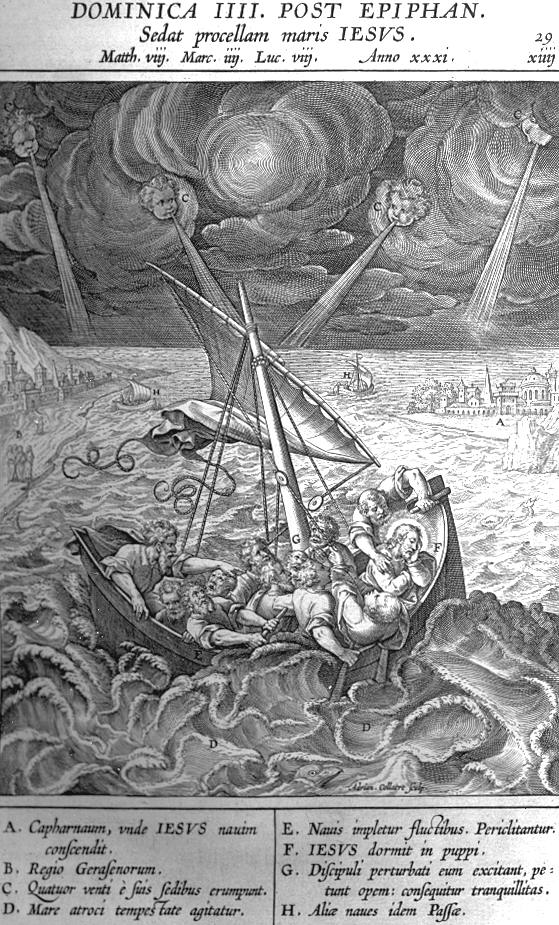
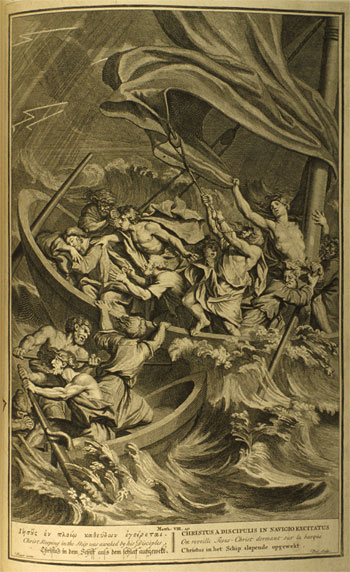
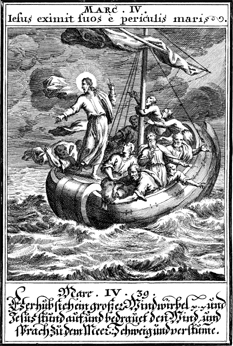
A great gale arose,
and the waves beat into the boat,
so that the boat was already being swamped.
But he was in the stern,
asleep on the cushion;
and they woke him up and said to him,
‘Teacher,
do you not care that we are perishing?’
He woke up and rebuked the wind
Mark 4:37-39 NRSV

One of the factors within the stilling of the storm is the fact that Jesus is asleep, and the disciples are worried and think that he doesn't care.

Within Mark's Gospel (and the other synoptics, but we are dealing with Mark here. To me it makes sense to compare Mark with Mark. It is his wording and version of events that is being looked at.) this is the only time Jesus is actually stated as being asleep. This isn't to say that He didn't sleep at other times. In fact, when He does stay up all night, a point is made of it. However, the fact that this is the only time Mark actually mentions Jesus sleeping may be of some import.

Within the Psalms of the OT sleep is used in two different ways. One expresses an idea of when things are bad, God is viewed as being asleep:
Rouse yourself! Why do you sleep, O Lord?
Awake, do not cast us off for ever!
Why do you hide your face?
Why do you forget our affliction and oppression?
Psalm 44 23-24 NRSV
This is how the disciples on the boat are thinking.

Another representation where being able to sleep can represent complete trust in God:
I will both lie down and sleep in peace;
for you alone, O Lord,
make me lie down in safety.
Psalm 4:8 NRSV
This is how Jesus is represented in the boat. He has complete faith in the Father. Storm or no, He knows it will be fine. This may be a little easy however.

In this case, I think the agony at Gethsemane may hold the meaning
On the boat, it is Jesus who is asleep, and the disciples who wake him up.
In Gethsemane, Jesus asks the disciples to stay awake, yet they fall asleep.
‘Abba,
Father,
for you all things are possible;
remove this cup from me;
yet,
not what I want,
but what you want.’
Mark 14:36 NRSV
Here, Jesus lets us know what the whole point of it is. It is about what we want, or think is fair. It is really about letting go. It is about trusting, faith, and knowing that what God wants for us is.

I have to admit I am finding this the most difficult part of all this. I really want to say that when Jesus was aware of the full extent of what lay in store for Him at Calvary, He too was worried. He too asked God the Father to sort it out for Him. But it isn't that simple. He adds, that He is aware it is not His decision, but the Father's. He was aware of the awfulness of what was to occur, yet He had total faith in God the Father. He trusted.

If we are Christians, how do we respond? When our lives turn to mush?

‘Why are you afraid?
Have you still no faith?’

Monday, June 15, 2009

Is there anybody out there?


‘Teacher, do you not care that we are perishing?’

‘Why are you afraid? Have you still no faith?’

These two phrases are key to what the passage of the stilling of the storm is really about, and what we can take from it for our own lives.

The storm of course represents any form of grief that we may be going through.
Depression, illness, unemployment, anxiety, lack of money, lonliness, tension, conflict.....
The list could go on and on.

Within the context of the story, the storm arrives very quickly. A few moments ago, Jesus was teaching. Of the go, to the other side, then the clouds gather. If it was looking too dodgy, I doubt they would have decided to cross. Also, the fact the Jesus has had time to have a little kip gives us an idea of the length of the voyage.

The point is that these storms can come up on us quickly. An extra bill in the mail can change a whole month, can change all sorts of plans. Can change hope into despair. A fall may brake a bone. A cold can turn into a flu, from a sniffle to a week in bed. Who's going to cook dinner? A discussion can quickly turn into a disagreement, into a feud. A friend can move away to another city, or country. A friend may pass away. All of a sudden we may realise that we are in fact quite alone.

It is at these moments we can be like the disciples in the boat with Jesus:
‘Teacher, do you not care that we are perishing?’
"Why am I going through this?"
"What have I done to deserve this"
"How come this is happening now?"
"Lord, help me through this"

We feel we have been deserted by God, we are alone in the storm. It seems as though God does not care.

In the reading, Jesus sorts the storm out. Then He says
‘Why are you afraid? Have you still no faith?’
Indeed.
Why do we assume that things going wrong, the storm, means God does not care?

Monday, June 8, 2009

That'll learn 'em


Christ Stilling the Waves
Edward Burne Jones
(1880)

On that day,
when evening had come,
he said to them,
‘Let us go across to the other side.’

And leaving the crowd behind,
they took him with them in the boat,
just as he was.
Other boats were with him.

A great gale arose,
and the waves beat into the boat,
so that the boat was already being swamped.

But he was in the stern,
asleep on the cushion;
and they woke him up and said to him,
‘Teacher, do you not care that we are perishing?’

He woke up and rebuked the wind,
and said to the sea,
‘Peace! Be still!’
Then the wind ceased,
and there was a dead calm.

He said to them,
‘Why are you afraid?
Have you still no faith?’

And they were filled with great awe and said to one another,
‘Who then is this,
that even the wind and the sea obey him?’
Mark 4:35-41 NRSV


I am currently preparing my second sermon of the year, based on the above passage.

It is a wonderful section of the Gospels, and Mark's version is my favourite telling of this event. In typical Marcan fashion, he places the moods of the disciples closer to the surface than the other evangelists. Throughout Mark, the disciples seem hopeless, they don't understand anything, and seem to constantly need reassurance. They doubt Jesus' divinity.

Yet, in Mark, Jesus is also a bit stroppier. The episode where he curses the fig tree, and in the above passage:

He said to them,
‘Why are you afraid?
Have you still no faith?’
In Matthew and Luke, He is gentler toward them; he understands they not understanding. Here in Mark, you can almost hear His frustration. How much more will they need? As we know, it will take a lot more than just claming a storm to prove who He is.
Before going into some homelitical exegesis, there are two bits of information that aren't in the reading, but from earlier within the same chapter.
Again he began to teach beside the lake.
Such a very large crowd gathered around him that he got into a boat on the lake
and sat there,
while the whole crowd was beside the lake on the land.
Mark 4:1 NRSV
This lets us know where Jesus was, the fact that He was already in the boat, and that He had been teaching there before. This was not a new occurance, but I suspect this is the largest crowd He has had up to this point. There were so many people, He had to step into the boat, either for the sake of space, or to gain height so a larger than expected crowd could hear and see Him.

I like to think there is something about the fact that He alone is on water, while severyone else is on land. Something for further investigation.

Jesus then taeches in a series of parables. After this Mark informs us:

he did not speak to them except in parables,
but he explained everything in private to his disciples.
Mark 4:34 NRSV

To the average punter, He spoke in mysterious tales. Those who get it will get it. However, He will explain all this in full to His disciples. I can't help but think that the stilling of the storm is one such occasion.

Jesus sleeps, the storm comes, the disciples freak out and complain to Him that He doesn't care. Was this a test? Was the stilling of the storm an enacted parable to teach faith?


Friday, May 22, 2009

The Parable of the Wicked Tenants


Here is another essay that has been causing me grief.
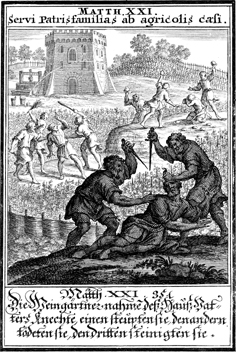
Jesus teaching with Parables consists of using the unknown with known, the strange with familiar.[1] The parable of the Wicked Husbandmen is unique among the parables of Jesus due to it essentially being an allegory. Here the vineyard is Israel, the landowner is God, the slaves are the prophets, the tenants are the religious leaders of the time, and the son is Jesus Christ. But this is really only half the story. It is the way that this allegory is used within a realistic context that makes it so powerful.

In Isaiah 5:7 the House of  Israel is represented as a vineyard. This use of Isaiah  shows the reference  to the vineyard and the owner are not to be understood as “earthly”, but representations of Israel and God.[2] All three synoptists use this allegory. Matthew and Mark add imagery from Isaiah 5:1-2: the setting of a hedge, the digging of a winepress, and the building of a tower. Luke omits this clear allusion to Isaiah, but his readers would still have understood the general reference of the vineyard.[3] The planting and care of a vineyard are signs of a prudent householder.[4]

At this time in Palestine and Galilee, many landowners were absentees.[5] This gives the parable a sense of reality, as there was unrest due to landlords living elsewhere[6] Luke adds to this “for a long time,” to emphasize the amount of responsibilty given to the tenants, to state they were trusted.[7] It is the owner’s absence rather than his departure that is illustrated in the parable. The God of Israel is being represented as an absentee landlord. [8] The absence represents the distance between God and the religious leaders of the time, due to their own withdrawal.[9] His absence is in actuality theirs. He had not forgotten them; he will send his slaves, and his only son.[10]


In Mark and Luke, the slaves are sent “in season”.  Due to the winepress being mentioned, this would be the time of winemaking, not the actual harvest as is stated in Matthew.[11] Either way the slaves are sent at appropriate times in history of salvation.[12] The sending of slaves refers to the sending of prophets.[13] The slaves are arranged and treated differently in each version. In Matthew, the slaves are sent in two groups; this may represent the former and latter prophets.[14] In Mark they are sent as individuals to portray the distinctive message of each prophet.[15] In Luke a single slave is sent each time, the violence each time escalating, climaxing in the killing of son.[16] Whether the next messengers are sent in the same season or the next is not stated, but the central point is that the trouble does not start straight away. Not only are the husbandmen given several opportunities to pay their rent, the message to do so is delivered in differing ways by different people.[17]

By using the same nomenclature as was used at both Jesus’ baptism and transfiguration, “beloved son” alludes to a christological interest.[18] The sending of the son is not only theological; it follows the logic of the story.[19] The owner expects his son will be well received. The arrival of son allows the tenants to think the owner has died.[20] Earlier it had been just slaves who had been sent who had no personal interest in estate. The one and only son is sharply contrasted with many slaves.

This is stated elsewhere in the New Testament:[21]
Long ago God spoke to our ancestors in many and various ways by the prophets, but in these last days he has spoken to us by a Son, whom he appointed heir of all things.
Hebrews 1:1-2 (NRSV)

The owner represents God by showing mercy and being long suffering.[22] By pursuing the contractual arrangements to end, he shows Gods fidelity.[23]

In Matthew and Luke, the son is thrown outside, and then killed.[24] This is similar to the Passion story in Matthew, where Jesus is crucified outside the city.[25] This analogy is awkward, as the vineyard represents Israel, not Jerusalem.[26] In Mark, the body cast out unburied as a final insult.[27]


To understand parable it is essential that the owner is living away. By removing the sole heir, the tenants can take unhindered possession. The law states that under specific circumstances an inheritance may be regarded as ownerless property, which may be claimed by any one, with the proviso that the priority right belongs to the claimant who comes first. [28]

At this point in the parable, Jesus uses a quote from Psalm 118.  Jesus’ view of the Old Testament was very spiritual, he felt it transcended his own age. He would have seen in Psalm 118 not a direct reference to himself, but only “the statement of a principle applicable to himself.” [29]

Psalm 118 was one of the primitive church’s proof texts for the resurrection and exaltation of rejection of Christ.[30] The whole of psalm 118 is a vindication of Gods purpose. This final week of Jesus’ earthly ministry is to be seen in the light of Gods victory snatched from defeat, God’s selection of his own people, and the new Kingdom of God, in gathering of the elect into Father.

The cornerstone referred to is the head of the corner, the stone used in buildings corner to bear stress and weight of the two walls; it is crucial to whole structure. It is this elevation of rejected stone into its predestined place at the head of the corner in which the Psalmist see the hand of God.[31] 

This rejected stone will become a stumbling block, as stated in Isaiah:

He will become a sanctuary, a stone one strikes against; for both houses of Israel he will become a rock one stumbles over—a trap and a snare for the inhabitants of Jerusalem. And many among them shall stumble; they shall fall and be broken; they shall be snared and taken.
Isaiah  8:14-15 NRSV
The stone of offence is God, a refuge and sanctuary to those who trust in Him, a snare to the faithless. This speaks of the refusal of Israel’s leaders to put their trust and confidence in God’s will.[32]
A chief cornerstone would not be likely to trip or fall on a person.[33] Christ will be a stumbling block for some, and they will suffer heavily for their shortsightedness.


In between the quote from Psalm 118, and the clear reference to Isaiah 8:14-15, Matthew adds the following:

Therefore I tell you,
the kingdom of God
will be taken away from you
and given to a people
that produces the fruits of the kingdom. 
Matthew 21:43 NRSV

In Matthew alone is the Vineyard referred to as the kingdom of God. [34] The kingdom is not only of future, the vineyard is underdeveloped, because it has been in possession of those who were unworthy. Vineyard in wrong hands will not bear fruit. No nation or people will have a permanent right to the vineyard.
Because the rulers will kill the Messiah, the vineyard, the Kingdom of God will be taken from them. It will be given to others.[35] The vineyard should be given to all, not one nation. [36] The “Israel of future” will be advanced to honour by the death of the only son. A judgement on Israel’s rulers is a conclusion that is impossible to resist, and also reflects tensions between Jew and Gentile.[37] Owner will come to sort it out.[38]


While the parable of the Wicked Husbandmen may be a very lofty allegory, it is its realism that makes it so tangible. It is a resemblance to a social reality. First, it has a strong resemblance to social reality. The fact that there was unrest in Palestine and Galilee due to landlords living elsewhere,[39] starts the parable off in a realist way. Another element Jesus audience would have understood was that the “payment in kind” which the tenants were to pay the landowner had led to many disputes with dishonest tenants who had leases.[40] None of this is really unusual for Jesus’ teaching; he was always vindicating the poor, the despised and alienated.  Here the tenants have opposed and rebelled against God. The rulers will be dispossessed. They will not only lose the blessing offered, but what they reject will actually cause their overthrow.

Bibliography

Albright, W.F.; Matthew (1986) Doubleday: New York

Allen, Willoughby C.; A Critical and Exegetical Commentary on the Gospel according to St. Matthew (19??) Edinburgh: T. & T. Clark

Creed, J.M.; The Gospel according to St. Luke (1930) MacMillan: London

Dodd, C.H.; The Parables of the Kingdom (1961) Fontana: London

Dormanday, Richard; “Hebrews 1:1-2 and the parable of the wicked husbandmen” in The Expository Times (Vol 100. No. 10; July 1989) pp. 371-375

Fitzmyer, Joseph A.; Luke (1985) Doubleday: New York

Gould, Ezra P.; A Critical and Exegetical Commentary on the Gospel according to St. Mark (1921) Edinburgh: T. & T. Clark

Inge, W.R.; The Gate of Life (1935) Longmans, Green and Co: London

Jeremias, Joachim; The Parables of Jesus (1963) SCM Press: London

McNeile, Alan Hugh; The Gospel According to St. Matthew (1957) MacMillan: London

Mann, C.S.; Mark (1986) Doubleday: New York

Oesterley, W.O.E.; The Gospel Parables in the Light of their Jewish Background (1936) SPCK: London

Plummer, Alfred; A Critical and Exegetical Commentary on the Gospel according to St. Luke (19??) Edinburgh: T. & T. Clark

Swete, Henry Barclay; The Parables of the Kingdom (1920) MacMillan: London

Swete, Henry Barclay; The Gospel according to St. Mark (1909) MacMillan: London