Pages

Showing posts with label Parables. Show all posts

Monday, March 11, 2013

I am no longer worthy to be called your son


I am no longer worthy to be called your son.
But when this son of yours came back
Son, you are always with me, and all that is mine is yours
This parable is mainly known as “The Prodigal Son.”
While there is nothing wrong with that title, it doesn’t really do justice to the whole of the story.
The story is not just about the son.
It is about the father.
It is about the older brother.

 It is about the relationships between all three:
father and younger son, father and eldest son. It is about the relationship between the two brothers.

I am no longer worthy to be called your son.

This is how the youngest son feels when he comes to himself after his journey into dissolute living.

Why does this mean he is no longer worthy to be called his father’s son?

His behaviour is one reason, but we need to remember that he asked his father for his share of the inheritance.
This was due to him, yes, but not until his father died.
By asking for it early, he is saying that his father is dead to him.
There is great pain here. Yes his behaviour and squandering the money is selfish and short sighted, but his desire to get it before his father’s death is difficult.

 But when this son of yours came back

The son has returned back home, and his father has welcomed him back with an overwhelming joy.

The speech he has prepared in his mind

"Father, I have sinned against heaven and before you;
I am no longer worthy to be called your son;
treat me like one of your hired hands."

He does not get to finish: he is cut off by his father’s extravagant overwhelming love.
He doesn’t get to say: treat me like one of your hired hands.

He does repent, but he does not need to degrade himself.

But the speech when compared what the elder son says reveals much:

'Listen! For all these years I have been working like a slave for you,
and I have never disobeyed your command;
yet you have never given me even a young goat so that I might celebrate with my friends.
But when this son of yours came back, who has devoured your property with prostitutes,
you killed the fatted calf for him!' 

Where the younger brother felt he was no longer worthy of being called a son, the elder brother feels he has been treated like a slave.

Both siblings feel in some way they are no longer sons.
One feels he is not worthy, the other that he has not been treated like a son.

Furthermore, the elder son no longer feels kinship with his brother:

But when this son of yours came back

He has disowned his brother, and feels he has been treated like a slave by his father.
Note, he must have been feeling this resentment before his brother returned home.


So, who really is lost?
The younger son left, misbehaved, repents and returns.
The elder son stays, works hard, and feels mistreated.

Who is the lost son?
Who has the father really lost?

The elder son feels he has lost his brother and his father.
His resentment at his father’s forgiveness means he is removed from both his father and his brother.

God’s forgiveness and love for us is confronting and reassuring.
Like the younger son we sometimes go far away, selfishly doing what we want, not thinking of what God or those closest to us want and need from us.

Like the younger son, we also come to ourselves.
We realise how far we have gone, and make our way back.

Always, God is there. He only needs to feel our sorrow in what we have done.
He does not need us to denigrate ourselves.

But I can’t help but feel that those of us in the church are a bit more like the elder son.
We are always here.
We are the ones who keep the place going.
We are the ones who pray for everyone.
We are the ones who will help the dying.
We are the ones who deserve God’s love.

We feel like we have worked like slaves, keeping our noses clean, doing everything right.

We see those outside of us.
We may say they are as deserving of God’s love as we are, but do we really mean it?
Are we not a bit like the elder son?

But when this son of yours came back, who has devoured your property with prostitutes, you killed the fatted calf for him.

Sometimes it is very difficult to accept how forgiving God is.
It can feel like we have been ripped off

I have never disobeyed your command;
yet you have never given me even a young goat so that I might celebrate with my friends.

We do not earn God’s love.
We do not earn God’s forgiveness.
It is by God’s grace that we receive his love and forgiveness.

And God asks us to do the same to others.

Forgive us our sins and we forgive those who sin against us

The father says to the elder son:

'Son, you are always with me, and all that is mine is yours. 
He is saying:
I love you.
I have always loved you.
I am with you to the end of the age.
My love is big enough for everyone there has ever been and ever will be.
It does not mean I love you any less, or my love is worth any less.

God forgives us all we do wrong.
He asks us to do the same for others he loves.


Friday, May 22, 2009

The Parable of the Wicked Tenants


Here is another essay that has been causing me grief.
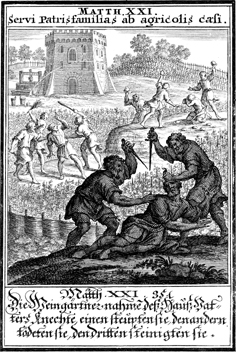
Jesus teaching with Parables consists of using the unknown with known, the strange with familiar.[1] The parable of the Wicked Husbandmen is unique among the parables of Jesus due to it essentially being an allegory. Here the vineyard is Israel, the landowner is God, the slaves are the prophets, the tenants are the religious leaders of the time, and the son is Jesus Christ. But this is really only half the story. It is the way that this allegory is used within a realistic context that makes it so powerful.

In Isaiah 5:7 the House of  Israel is represented as a vineyard. This use of Isaiah  shows the reference  to the vineyard and the owner are not to be understood as “earthly”, but representations of Israel and God.[2] All three synoptists use this allegory. Matthew and Mark add imagery from Isaiah 5:1-2: the setting of a hedge, the digging of a winepress, and the building of a tower. Luke omits this clear allusion to Isaiah, but his readers would still have understood the general reference of the vineyard.[3] The planting and care of a vineyard are signs of a prudent householder.[4]

At this time in Palestine and Galilee, many landowners were absentees.[5] This gives the parable a sense of reality, as there was unrest due to landlords living elsewhere[6] Luke adds to this “for a long time,” to emphasize the amount of responsibilty given to the tenants, to state they were trusted.[7] It is the owner’s absence rather than his departure that is illustrated in the parable. The God of Israel is being represented as an absentee landlord. [8] The absence represents the distance between God and the religious leaders of the time, due to their own withdrawal.[9] His absence is in actuality theirs. He had not forgotten them; he will send his slaves, and his only son.[10]


In Mark and Luke, the slaves are sent “in season”.  Due to the winepress being mentioned, this would be the time of winemaking, not the actual harvest as is stated in Matthew.[11] Either way the slaves are sent at appropriate times in history of salvation.[12] The sending of slaves refers to the sending of prophets.[13] The slaves are arranged and treated differently in each version. In Matthew, the slaves are sent in two groups; this may represent the former and latter prophets.[14] In Mark they are sent as individuals to portray the distinctive message of each prophet.[15] In Luke a single slave is sent each time, the violence each time escalating, climaxing in the killing of son.[16] Whether the next messengers are sent in the same season or the next is not stated, but the central point is that the trouble does not start straight away. Not only are the husbandmen given several opportunities to pay their rent, the message to do so is delivered in differing ways by different people.[17]

By using the same nomenclature as was used at both Jesus’ baptism and transfiguration, “beloved son” alludes to a christological interest.[18] The sending of the son is not only theological; it follows the logic of the story.[19] The owner expects his son will be well received. The arrival of son allows the tenants to think the owner has died.[20] Earlier it had been just slaves who had been sent who had no personal interest in estate. The one and only son is sharply contrasted with many slaves.

This is stated elsewhere in the New Testament:[21]
Long ago God spoke to our ancestors in many and various ways by the prophets, but in these last days he has spoken to us by a Son, whom he appointed heir of all things.
Hebrews 1:1-2 (NRSV)

The owner represents God by showing mercy and being long suffering.[22] By pursuing the contractual arrangements to end, he shows Gods fidelity.[23]

In Matthew and Luke, the son is thrown outside, and then killed.[24] This is similar to the Passion story in Matthew, where Jesus is crucified outside the city.[25] This analogy is awkward, as the vineyard represents Israel, not Jerusalem.[26] In Mark, the body cast out unburied as a final insult.[27]


To understand parable it is essential that the owner is living away. By removing the sole heir, the tenants can take unhindered possession. The law states that under specific circumstances an inheritance may be regarded as ownerless property, which may be claimed by any one, with the proviso that the priority right belongs to the claimant who comes first. [28]

At this point in the parable, Jesus uses a quote from Psalm 118.  Jesus’ view of the Old Testament was very spiritual, he felt it transcended his own age. He would have seen in Psalm 118 not a direct reference to himself, but only “the statement of a principle applicable to himself.” [29]

Psalm 118 was one of the primitive church’s proof texts for the resurrection and exaltation of rejection of Christ.[30] The whole of psalm 118 is a vindication of Gods purpose. This final week of Jesus’ earthly ministry is to be seen in the light of Gods victory snatched from defeat, God’s selection of his own people, and the new Kingdom of God, in gathering of the elect into Father.

The cornerstone referred to is the head of the corner, the stone used in buildings corner to bear stress and weight of the two walls; it is crucial to whole structure. It is this elevation of rejected stone into its predestined place at the head of the corner in which the Psalmist see the hand of God.[31] 

This rejected stone will become a stumbling block, as stated in Isaiah:

He will become a sanctuary, a stone one strikes against; for both houses of Israel he will become a rock one stumbles over—a trap and a snare for the inhabitants of Jerusalem. And many among them shall stumble; they shall fall and be broken; they shall be snared and taken.
Isaiah  8:14-15 NRSV
The stone of offence is God, a refuge and sanctuary to those who trust in Him, a snare to the faithless. This speaks of the refusal of Israel’s leaders to put their trust and confidence in God’s will.[32]
A chief cornerstone would not be likely to trip or fall on a person.[33] Christ will be a stumbling block for some, and they will suffer heavily for their shortsightedness.


In between the quote from Psalm 118, and the clear reference to Isaiah 8:14-15, Matthew adds the following:

Therefore I tell you,
the kingdom of God
will be taken away from you
and given to a people
that produces the fruits of the kingdom. 
Matthew 21:43 NRSV

In Matthew alone is the Vineyard referred to as the kingdom of God. [34] The kingdom is not only of future, the vineyard is underdeveloped, because it has been in possession of those who were unworthy. Vineyard in wrong hands will not bear fruit. No nation or people will have a permanent right to the vineyard.
Because the rulers will kill the Messiah, the vineyard, the Kingdom of God will be taken from them. It will be given to others.[35] The vineyard should be given to all, not one nation. [36] The “Israel of future” will be advanced to honour by the death of the only son. A judgement on Israel’s rulers is a conclusion that is impossible to resist, and also reflects tensions between Jew and Gentile.[37] Owner will come to sort it out.[38]


While the parable of the Wicked Husbandmen may be a very lofty allegory, it is its realism that makes it so tangible. It is a resemblance to a social reality. First, it has a strong resemblance to social reality. The fact that there was unrest in Palestine and Galilee due to landlords living elsewhere,[39] starts the parable off in a realist way. Another element Jesus audience would have understood was that the “payment in kind” which the tenants were to pay the landowner had led to many disputes with dishonest tenants who had leases.[40] None of this is really unusual for Jesus’ teaching; he was always vindicating the poor, the despised and alienated.  Here the tenants have opposed and rebelled against God. The rulers will be dispossessed. They will not only lose the blessing offered, but what they reject will actually cause their overthrow.

Bibliography

Albright, W.F.; Matthew (1986) Doubleday: New York

Allen, Willoughby C.; A Critical and Exegetical Commentary on the Gospel according to St. Matthew (19??) Edinburgh: T. & T. Clark

Creed, J.M.; The Gospel according to St. Luke (1930) MacMillan: London

Dodd, C.H.; The Parables of the Kingdom (1961) Fontana: London

Dormanday, Richard; “Hebrews 1:1-2 and the parable of the wicked husbandmen” in The Expository Times (Vol 100. No. 10; July 1989) pp. 371-375

Fitzmyer, Joseph A.; Luke (1985) Doubleday: New York

Gould, Ezra P.; A Critical and Exegetical Commentary on the Gospel according to St. Mark (1921) Edinburgh: T. & T. Clark

Inge, W.R.; The Gate of Life (1935) Longmans, Green and Co: London

Jeremias, Joachim; The Parables of Jesus (1963) SCM Press: London

McNeile, Alan Hugh; The Gospel According to St. Matthew (1957) MacMillan: London

Mann, C.S.; Mark (1986) Doubleday: New York

Oesterley, W.O.E.; The Gospel Parables in the Light of their Jewish Background (1936) SPCK: London

Plummer, Alfred; A Critical and Exegetical Commentary on the Gospel according to St. Luke (19??) Edinburgh: T. & T. Clark

Swete, Henry Barclay; The Parables of the Kingdom (1920) MacMillan: London

Swete, Henry Barclay; The Gospel according to St. Mark (1909) MacMillan: London