Pages

Sunday, April 15, 2012

Homily for Easter 2

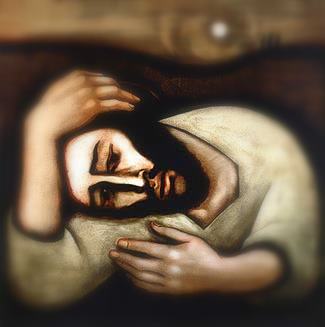
DOUBTING THOMAS by Bob Kessel after Caravaggio

Do not doubt but believe.

The risen Christ and the doubting Thomas.

This is the whole climax of John’s Gospel. In this interaction, the whole essence of faith, and what belief actually is and how it works in illustrated in one scene.

Jesus has visited the disciples and given them the gift of the Holy Spirit. This is in many ways the Pentecost of Johns Gospel. This must have been a huge joy filled occasion.

But, Thomas, was not there.
We don’t know what he was doing, but we can hazard a guess that he was on his own, mourning the death of Jesus.

Thomas, of all the disciples shows the most human qualities. He is impulsive, he is forthright. He doubts.

He is called the twin, or didymus. Didymus can mean twin, or double tongued. It can mean being in two minds. It is the idea of there being another side to what there is. The two sides we are dealing with here are faith and doubt.

So, the disciples come and tell Thomas in all their joy, “We have seen the lord!”

Thomas is sceptical. “What do they mean, seen? What have they actually seen? How can it possibly be Jesus? We all saw him die on the cross.”

Thomas has so many reasons why it could in no way be Jesus that they have seen. They must be deluded, or have been conned by some charlatan.

He states his criteria to them. 

"Unless I see the mark of the nails in his hands, and put my finger in the mark of the nails and my hand in his side, I will not believe."

Physical proof. Unless he can see or feel, he will not believe.
Seems fair enough.  That’ll show them.

A week later, Thomas gets his chance.
What he had suggested, probably in an attempt for them to see reality, happens.

Jesus appears, and says:

"Put your finger here and see my hands. Reach out your hand and put it in my side.   Do not doubt but believe."

Jesus is saying “Whatever you need Thomas, whatever it will take, whatever it is you have asked to believe that I am Christ who has conquered death, who has risen and is now here in front of you. If you need to touch, here I am. Thomas, I will do anything it takes for you to believe.”

Thomas is obviously overwhelmed. He doesn’t need to touch Jesus. He only needs to see him, and he says:

"My Lord and my God!"

Jesus has managed to bring Thomas from doubt to faith.

From a fading belief to a full profession of the Christian: belief in the divinity of Jesus.

The thing here is that Jesus wants Thomas to believe. He wants him to be with him where he is.

This is same for us, for everyone. Jesus wants us to be with him. He knows that we are all different. He knows that we all here today in different stages of our journey.  He meets everyone where they are. He meets those who don’t know him, and patiently waits.

But Jesus doesn’t let him off the hook so easily:

"Have you believed because you have seen me? Blessed are those who have not seen and yet have come to believe."
And it is here that we come in. This is really said to us. It was said for the first believers who were not present at the appearances of Jesus after his resurrection. It was said for all those who have followed since.
 
But we have all been like Thomas at some point.
Moments where we have doubted parts of the faith, or even doubted the whole thing.
Dark times where it seems there is no point, and God has forsaken us.

Doubt is a part of life.
Doubt is a part of faith.

It is impossible to have faith without doubt. They are two sides of the same thing.
Without doubt there cannot be faith.
To have doubts means we have accepted that faith is not static but is a journey.

Thomas was despairing because the one who he was following had been put to death.
In that darkness he was doubting all he had been through. 
But from that doubt, he found faith.
From within his doubt, Jesus pulled out faith.
Within our doubt, we find faith.

Jesus says to Thomas, “Do not doubt, but believe.” 
He wants Thomas to believe, he wants us to believe.
Jesus is prepared to meet us where we are, and that can, and often is, in a place of doubt.

Unlike Thomas we don’t Jesus physically coming to find us. But what we do have is the knowledge that those who have not seen and yet have come to believe are blessed.

To stay in a state of doubt is not what we want to do, and it is not what Jesus wants us to do. As he says to Thomas: Do not doubt, but believe.

However, there is the idea that from within doubt there is belief, within the despair there is hope. From within doubt, faith will arise.


Friday, April 6, 2012

Homily for Maundy Thursday


For I have set you an example, that you also should do as I have done to you.


We have begun the Great Three Days.
And here we are, in the upper room.
This evening where Jesus shares his final meal with the disciples.
This evening where Jesus washes the disciples feet.
On this evening Jesus shows us what it means to serve, and also, he teaches us how to accept being served.

Jesus shows the disciples what dignity there is in the Kingdom of God by serving them in the most menial way he could.

He is possessed by a special sense of his divine commission and authority. And how does he express this? Does he ask for a throne to be placed in the middle of the room? Does he ask for a crown?
No.
           
He got up from the table,
took off his outer robe,
and tied a towel around himself.

Then he poured water into a basin
and began to wash the disciples' feet
and to wipe them with the towel that was tied around him.

We shrink from this.
We are ok with being humble before God.

We don’t want him to be humble in his dealings with us.

We want him to be glorious.
We want to be in that presence,
but when we are we may sometimes think we are entitled to pride ourselves on that achievement,
We may begin to think we might be better than others.

But, the worship of Jesus makes a nonsense of such ideas.
The worship of baby for whom there was no room at the inn.
The worship of jesus who humbles himself to kneel and wash feet.

If worship is genuine, any sense of pride is eliminated. Jesus who we worship is humility incarnate.

This divine humility shows itself in service.  As Jesus says “the Son of Man came not to be served but to serve,”


But our humility doesn’t come from serving, but rather our willingness to be served.

There can be much pride and condescension in our serving.
It is only really true when it is spontaneous and comes from a place of love.
Any offer we do that is planned or forced is flawed and comes from our own will,
rather from that of God.
We are doing our work, not God’s.
It is self centred not God centred.

It is difficult to show our humility in our service.

Our humility will come from our willingness to be served by others, and by God.
To accept be served by someone is to admit dependence on them. The desire to not owe someone, or to be beholden to them is ultimately unchristian. It is as unchristian as to take all and offer nothing.
  
 As Jesus loved the disciples, we are to love each other. Also, we are also to accept that love. That is in many ways more difficult. It is difficult sometimes for us to let someone do something for us. It is difficult because we are proud. We like to think we can do on our own. Our sense of self is diminished when we feel we need help. Our sense of who we are can crumble when we can’t accomplish something we need to do, or something we used to be able to do.

To let others serve us is to show great humility. As Jesus showed divine humility by washing the disciples feet, we can show our human humility by allowing others to serve us. To allow ourselves to be vulnerable and admit that we sometimes need help. To admit there are things we can’t. As Jesus served the disciples, we are to serve those around us. And as the disciples accepted that service, we are also to accept being served.

Love is not a one way street. To love one another means also accepting love from one another. It is sometimes hard for us to believe that someone else may love us for who we are.
Jesus loves us for who we are.
He asks us to love one another, and he also asks us to allow ourselves to be loved by one another.

Sunday, March 4, 2012

Homily for the Second Sunday of Lent


 “You are setting your mind not on divine things but on human things."


How we live, how we struggle, how we love, how we let our selves down, how we sort things out, is all dependent on how we see things.

Our point of view in any situation is going to govern our response to what is said or is being done. Our difficulty is that we don’t always see as we need to, or we don’t see as God wants us to see.

This is the state we find peter in this morning. Peter knows that Jesus is the Messiah. He has all sorts of understanding of what that means. It may have meant some sort of warrior who would free Israel from oppression. He would be a political victor who would lead Israel to a life of peace and abundance.

Peter is about to find out that the way God sees things is different to how he humans see things.

Jesus tells Peter and the disciples that he, the Son of man must undergo great suffering,
and be rejected by the elders,
the chief priests,
and the scribes,
and be killed,
and after three days rise again

Peter doesn’t get it. This goes against all his ideas and dreams about the messiah. He has just confessed that he believes that Jesus is the Christ, then he gets this news.

It doesn’t tally with what he believes.
There is great dissonance between ideal and reality.

He rebukes Jesus, and Jesus casts Peter in the role of the great tempter, Satan, then
For you are setting your mind not on divine things
but on human things."

The way Peter is seeing things and the way God wants him to see are different.

But just previous to this passage, mark gives us a great clue to what is going on, with the healing of the blind man in Bethsaida.

Jesus lays hands on the man’s eyes, and asks him “Can you see anything?” The man looks up and says “I can see people, but they look like trees walking.” Then Jesus lays hands on his eyes again. The man looks intently, his sight is restored, and he sees everything clearly.

This is the same with Peter. He has rightly confessed that Jesus is the Christ, but he sees unclearly. His inability to accept the concept of the suffering messiah is like the blind man who sees people, but they look like trees walking.

He sees, but his perspective is off.  This like the first touch of Jesus on the blind man’s eyes. It will take a second touch for him to see clearly. This second touch won’t happen for Peter until after Jesus death and resurrection. It is only then that he will see clearly. It is only then that he will see as God wants him to see, not as he wants to see. But until then, Peter is setting his mind not on divine things but on human things."

Jesus follows this with what it will mean to be a disciple. This advice is for all who want to follow him, including us.
He does not offer us any easy way out. 
He does not offer us an easy way out of our trials.
He offers us a way through them.

This way through, is very counter cultural.

It was then, and in our world today it is even more so.
It goes against nearly everything our society and we in turn, stand for.
The way through requires seeing differently.
It requires seeing God It demands that we see ourselves differently.

Deny yourself.

Take up your cross.

To save your life you must lose it.

For what will it profit you to gain the whole world and forfeit your life?

When we follow these, we commit everything we have and are to God.
We give up our desires and our self interest to those of God.

But our society tells us to look after our individual wants and desires.
But to take up our cross means denying ourselves, not fulfilling our desires.

This is tough.

It requires us to see things not as we want to see them, but rather as God wants us to see them.

To take up our cross is to reorder our desires.

It is to bring to the surface the greatest desire: the desire that leaves beneath all desires and that only God can satisfy.

This desire that overwhelms all desires is the desire for God.

Following Christ means our minds and hearts are filled with this desire until every other desire pales in comparison.
Our desires are reordered, we see as God wants us to see.

When our minds are set on divine things rather than human things, our lives start to be reordered.

We realise that we don’t need to possess flash things to be satisfied.
We know that our value isn’t to be found in our wealth or possessions.
By looking toward the divine, we understand that what it is that makes us us is not the position we hold, or the power we wield, rather it is who we really are, it is how God sees us that find our true worth.

With our minds focused on God, our desires for control over ourselves and others start to seem meaningless and foolish.

We thrash around trying to force our will, but always to no avail.

By denying ourselves, taking up our cross, we reorder our desires to those God.

Our minds begin to be set on divine things.    


Sunday, February 19, 2012

Homily for the Last Sunday after Epiphany: The Transfiguration of Jesus


Then Peter said to Jesus, "Rabbi, it is good for us to be here;

The Transfiguration of Jesus atop a mountain is one of the amazing events in his life, yet outside of the church, it is very unknown. In terms of paintings and music, is very under represented. It seems that it is a confusing event for us, as it was for Peter.

It is good for us to be here.

This is what Peter says when he sees Jesus clothes dazzling white, so white that no fuller could bleach them so.

Not only is Jesus whole appearance in a state of metamorphosis, glowing, radiating as the sun, the source of this light being himself, he is joined by Moses and Elijah, the two most important old testament prophets.

I would suggest that this scene is, as Peter says, “good.”
It is more than good, this is truly marvellous.

Peter was given a taste of the perfect harmony of the divine life. The veil of mystery was for this moment lifted, and Jesus divine nature was revealed.

That’s “good.”

But Peter is saying more than “good.”

The word means more than good as in behaving well, or good that it was fortunate he was there, it means more like beautiful and wondrous.
Peters cry is really a recognition that he knows he is sharing in the beautiful, he was sharing in something divine.

We need to remember that six days before this event, Jesus had just given his first prediction of his coming passion, that he must suffer, die and rise again.

He had also informed the disciples of the true cost of being a disciple, that they were to take up their own cross if they were follow him, that they were to lose their own life. Heavy stuff.


With this is mind, it is no surprise that Peter was carrying on that it was good.

This moment of divine glory was a respite from daily ministry and a relief from thinking about the cost of discipleship.

He likes it so much he suggests that the moment be prolonged:
let us make three dwellings, he says

He wants this to go on forever. He looks back and sees the grind of daily ministry with its persecutions, and looks to the future and sees suffering.
It is understandable that he would want to keep this wonderful event going forever.

So, why was it good that Peter was there?  What did he make of it?

It can be seen as a promise.
It was promise to Peter, that although life was tough, and was certainly going to get tougher, it was going to work out.

The transfigured Christ was almost a sneak preview of the resurrected Christ.
It was a reassurance that though he, Jesus will be crucified and die, he will rise again.

But even more so, it was sign his divinity.

Peter had recognised the Jesus was the Christ. Here Jesus was revealing the full story. His revelation showed that he was beyond the norms of physicality and time. He was showing his true divine eternal nature.


But what about us. Why is it good that we hear about the transfigured Christ?

In fact, there are many Christians that think of the Transfiguration as unimportant.

But, Our Eastern Orthodox brothers and sisters think quite the opposite. For them, this day is third in importance only to Holy Week and Christmas.


But for us, we celebrate the Transfiguration before we go into Lent.

It is a last glimpse of Christ in glory before we celebrate the Christ in suffering of Good Friday.
And this makes some sense.
In Mark, once we are up the hill and Christ is transfigured,
we descend the mount,
and all sign and sights lead to Jerusalem and to the cross.

But the eastern Orthodox celebrate the Transfiguration in its own right, the transfiguration as a significant event in the life of Christ.

And their understanding of it as such is different.
For them too the transfiguration is a promise, but of a different kind. 

It is more a revelation of the potential spirituality of the earthly life in its highest outward form.

They see it as Jesus showing the capacity of humanity, he is showing what those who are united with him, are being lead to.

For the Eastern Orthodox, the transfiguration shows where we are heading.

And this is why it is good that we are here.

We can understand the transfiguration as a final piece of Christs glory before the wilderness of lent, an image of majestic divinity before we are confronted with the idea of a crucified God on Good Friday.

Or, we see in the Transfiguration the potential of humanity’s spiritual nature revealed by Christ to Peter and his companions and to us.

Either way, it is good that we hear about and pray about it together. 
You see, with other events in Christs life, we have to come to some understanding of them.

We need to get our heads around the incarnation. We need to confront and be confronted by the cross.

The transfiguration is different. It doesn’t demand an understanding.

But what it does do is invite us.

It invites us to go deep into prayer and contemplation.
The transfigured Christ invites us to deeper into our spiritual nature.
The transfigured Christ invites us to be united with him.
The transfigured Christ reveals his divinity for us to see,
and he invites us to share in that with him.

The transfigured Christ says to us “Come ”

So it is good that we are here.

It is good that we are here to be together as we contemplate the meaning of the transfiguration.
It is good that we are here to be reminded to prepare ourselves for Lent.
It is good that we are here to experience Christ’s presence in the eucharist.
It is good that we are here to be invited to share in Christ’s divinity with him.

As Peter said, It is good for us to be here.


Sunday, February 5, 2012

Homily for the 5th Sunday after Epiphany


In the morning, while it was still very dark, he got up and went out to a deserted place, and there he prayed.


In today’s Gospel, in many ways, we are shown what a day was like for Jesus. It seems that Mark has put together this section to show us the sort of things that occupied a normal day in Jesus ministry.

All the elements are there:  There is the call to follow, there is the teaching with authority, there is healing of body and mind. And lastly there is the retirement away for prayer.

It is interesting to note that in Mark, Jesus praying only gets mentioned 3 times. Once as we heard today, and another happens after the first feeding of the multitude:
After saying farewell to them, he went up on the mountain to pray.
The other happens in the garden at Gethsemane, where he said to his disciples, "Sit here while I pray."

The fact that mark only mentions Jesus praying three times is not to suggest that Jesus only actually prayed three times during earthly ministry. None of us would think that was possible. There are several common factors in each incident: Prayer is always alone, at night, and in times of stress

The stress is the reason for prayer.

It is most clearly stated in the events of the night before his crucifixion, when he takes three of the disciples to the garden at Gethsemane and as the Gospel tells us He “began to be distressed and agitated.  He tells the three of them "I am deeply grieved, even to death” then he makes his way apart from them to pray.

It is easy to see why Jesus would be stressed on that particular night. He knew exactly what was about to occur. Everything was turning out as he had predicted. Knowing what was about to occur the next afternoon is a fair enough reason to be stressed.

But what of the other two occasions? The incident after the first feeding of the multitude, where he says farewell to the disciples, and goes up to a mountain to pray, and the incident in today’s Gospel, where he is hunted out by the disciples, because they can’t find him.

I believe that it is still stress related.

In today’s Gospel, Jesus has healed the sick, proclaimed the word, and exorcised demons. The crowds are beginning to form, it seems as though it is reaching a fever pitch of excitement. Everyone who hears of his healings and exorcisms wants a part of it. They want a part of this miracle worker.

He teaches with authority, he heals the sick, even spirits obey him.

He really is something else.

But Jesus retires away to pray. We can think that it has been done to refresh himself ready for the next day of healing and preaching. Ready for the ever growing crowds.

The fact that things aren’t going to plan is revealed at two points.
We hear of Simon and his companions hunting for Jesus. Not the disciples, but Simon and his companions. Mark here is showing us that at this point they aren’t acting as disciples, but rather are acting on behalf of the people. They have come with a request from the crowds:

 "Everyone is searching for you."

Jesus answer tells us what is really going on:

"Let us go on to the neighbouring towns,
so that I may proclaim the message there also;
for that is what I came out to do."

All these healings, exorcisms, the preaching have done their job where he is. It is time to move on and proclaim elsewhere.

But it is more than this. Jesus is rejecting the crowds. He is rejecting the popularity. The excitement, the exorcisms, the healings, these were not his main purpose. This isn’t what he came to do. The day had really been a great strain and a disappointment to him. This was secondary stuff.

The primary stuff was to proclaim to proclaim the kingdom of God. This was primary. Healings and exorcisms were secondary.

The kingdom of god was primary. The effects and workings toward were secondary.

The healings and exorcisms are fine. There is nothing wrong with them, they are results of the coming kingdom.  They are secondary, they aren’t the main purpose.

This is a difficulty we find ourselves today. We get ourselves confused between the primary and secondary issues of the kingdom.  We worry about the roof on our church and place our energy on how to fix it. This may be important, but it is not the reason we gather.  We can get ourselves tangled up with the secondary issues of church that we forget why we are even doing them.

We can even convince ourselves that we are proclaiming the Kingdom, when really we are doing secondary work.  Meetings about who is on what team and who is going to make sure the accounts are up to date can feel like the primary work. But they aren’t. They are important, but they are only important in that they will help the proclaiming of the Kingdom of God.

Secondary issues can seem to be very positive. Gaining a crowd at church and the ways we do that are important, but this too is secondary. The primary purpose of anything we do is to proclaim the good news. The crowd may gather, but unless the kingdom is proclaimed, we are caught up in secondary issues.

This is tricky stuff. There are so many things that feel like they are the important part of our work, but they are secondary to what we are really about. Maybe these secondary issues are  like the demons Jesus was exorcising. They are there keeping us from what we are meant to be doing. They tell us that synods, meetings, and administration are what we need to do. It is nonsense. In reality they are things that keep us from what we are about.

And this is why Jesus removed himself and prayed. He saw the crowds, he worked the miracles, and he saw that this was becoming primary in the minds of everyone. His mission was railroaded into the secondary. He removed himself from everyone to centre himself, to hear what the Father needed him to be doing.

When we gather to hear God’s word, we are doing the same thing. This is a time out of the ordinary, a time when we get to hear what it is we are supposed to be doing, hearing about the things that matter. As we go about our week, the secondary issues will come in. That is fine, and they are impossible to avoid. But the trick is to remember why we do them. 

Monday, January 16, 2012

Homily for 2nd Sunday after Epiphany


You will see heaven opened and the angels of God ascending and descending upon the Son of Man.

If I had to pick one single verse, if it ever came to that, when for some bizarre reason, that each of us were only allowed one single verse of scripture, or when we pass through this stage of our physical lives, we have to account for ourselves with a single verse, this final line of the first chapter of John would be mine.

You will see heaven opened and the angels of God ascending and descending upon the Son of Man.

I must admit I prefer the older translation of this:

 Verily, verily, I say unto you, Ye shall see the heaven opened, and the angels of God ascending and descending upon the Son of man.

It has a certain sense of the power and presence of Jesus addressing Nathanael. 

I can still see, hear and feel the time I first heard it.

I read through the rest of gospel, eagerly waiting for this moment, when I would read about these angels and Jesus.
Chapter after chapter, they failed to appear.
I felt a bit ripped off.
I thought maybe the bible I had was missing a few pages.
They didn’t show up.
 This wasn’t too good for me as a new Christian, as here was a promise made by Jesus, but it wasn’t fulfilled.
I took some comfort by the promise at the end of John’s gospel that there many other things that Jesus did in his earthly life that weren’t recorded, and figured that this event was just one of them.

But that didn’t make sense.
How could something so marvellous as angels ascending and descending upon Jesus be “just another event” that could be left out?

I was confounded. I read as much as I can find on this passage, but found no general consensus on what it meant.
I prayed and meditated on the passage.  
What does Jesus mean?
What are these angels that will be seen?
Why is it they will be ascending then descending on upon him, the Son of Man?


One of the keys to this passage lies within the book of Genesis.
 In the same way that the writer John started his Gospel with a deliberate echo of the beginnings of Genesis, “In the beginning….’
Here he ends this section of Jesus ministry with another echo from Genesis, this time from the story of Jacob at Bethel, from chapter 28:

He came to a certain place and stayed there for the night, because the sun had set.
Taking one of the stones of the place, he put it under his head and lay down in that place.
And he dreamed that there was a ladder set up on the earth, the top of it reaching to heaven;
and the angels of God were ascending and descending on it.

So we have Jacob falling asleep and dreaming. In his dream he sees a ladder that reaches from the very soil to the very heights of heaven. He sees angels ascending and descending upon this ladder.

In his dream, God speaks and makes a covenant with Jacob. Jacob awakes from his sleep and says:

"Surely the LORD is in this place. How awesome is this place! This is none other than the house of God, and this is the gate of heaven."

So where Jacob recognises that the place he is in is Holy, and he goes on to anoint an altar to the Lord there, Jesus is using a phrase that has been used to express God’s presence, but this time it is not a place, it is a person, it is he, the Son of man.

Jacob recognises that where he is the very gate to heaven.
Jesus is saying that He himself is the same: he is the gate to heaven; he is the presence of God on earth.
Where with Jacob, the angels ascend and descend on a ladder, Jesus says they ascend and descend upon him.

So what John is doing at the beginning of his Gospel is setting the whole story of the incarnation, the idea of God in flesh, with the beginning of creation.
At the end of this section which deals with beginnings of Jesus’ earthly ministry, mainly his baptism by John and the calling of the first disciples.
He ends this section with a concept that really announces the arrival of God’s presence on earth.
 If you were in any doubt after the first section of this chapter, this last line really underlines the idea. Jesus is God incarnate.

This is all fine and well, but it still doesn’t explain where this happens, where these angels will ascend and descend on Jesus.


Now, angels are best understood as messengers of God.
They are not God, they are not man, they are a completely unique thing.
They are divine, but they are not God. They are messengers of God.
The Archangel Gabriel informed Mary of her role in incarnation. He was a messenger of God.

The angels Jesus speaks of are the same.
What they represent is a continual conversation between the father and the son. 
A continual conversation between the heavenly and earthly realms.
They are the gateway from earth to heaven, and they are the gateway from heaven to earth.
 It is a two way conversation. It is a two way conversation that centres on Jesus.
This passage not only underlines the incarnation, it also tells us what it means to us.

 And it is here that we need to read carefully. Jesus has been talking to Nathanael.

“You, (meaning Nathanael,) will see greater things than these”. 
But then it changes.

You, plural, You will see.
This plural you is important.
 It could be the other disciples around at the time, and Jesus is addressing the whole group.

I sense that it is more than this.

You, all of you, all who read this, all you who hear of Jesus, all you who recognise the Jesus as the Son of God, whenever, wherever, you will see heaven opened and the angels of God ascending and descending upon the Son of Man.

John is letting us know that as we read this gospel, what we are witnessing is this event.
Throughout the whole of the gospel, everything Jesus does and says is this event.
The event is in fact the very person of Jesus, the son of God.

 It isn’t a single event, it is a continuous thing, it is an eternal thing. God incarnate in the form of Jesus, and his continual presence as given to us by the Holy Spirit. All we have to do is look.

The promise to Nathanael is a promise to us.

By our lives lived together with Christ, we, and all who have ever believed, will see, do see, and  have seen, the angels of god ascending and descending upon the son of man, Jesus Christ, the son Of God, God incarnate.

This promise is for anyone who wants to see.
And as Nathanael was invited by Phillip, we too are invited, by the simple words: “Come and see.”


Wednesday, January 4, 2012

Homily for Epiphany


“we observed his star at its rising, and have come to pay him homage.”

The story of these magi is most likely the most popular Christian story that there is. This is a story that people, and most especially, people that aren’t church goers, really relate to. Three wise men on camels carrying gifts. For many, this is the symbol of Christmas.

Driving around Singleton this last fortnight to look at all the houses decorated with Christmas lights, I noticed that the three wise men and the star would only be second to father Christmas and Reindeer. Why these magi? Why not the shepherds? Why not the angels? Why not the infant Jesus?

 I think it is because of their very mysteriousness, but also it is the undeniable and intrinsic truth of their story.

The first we hear of them, they have arrived in Jerusalem, asking anyone who would listen:

"Where is the child who has been born king of the Jews?"

I imagine that many of those they asked had no idea what they were talking about. They hadn’t heard anything about a birth that was so special. But then the magi state how they know this information:

“For we observed his star at its rising, and have come to pay him homage."

Someone must have heard this and thought it important that King Herod knew about these foreigners wandering around hunting for the new born king of the Jews.

Herod is worried. He knows this is not good news for his rule. A divine ruler, the Messiah is going usurp any authority he has. He sees his days numbered.

He calls the chief priests and scribes to find out where this child is to be born. He needs the answer to the magi’s initial question:
"Where is the child who has been born king of the Jews?"

He asks the scribes and priests. They know their scriptures well. From prophecies in the books of 2nd Samuel and the prophet Micah, they can name the town of Bethlehem as the place.

What we can see here is God’s revelation to two groups of people in two different ways.

The Magi were Gentiles, non Jews. Gentiles were deprived of the scriptures, and so they were not given an explicit revelation as the Jews were. It was through nature that God revealed himself to the gentiles.

The magi receive their revelation through the stars. Their gazing and interpretation of the movement of the stars showed them something significant was happening Israel. They interpret the movement as being a birth star. So significant is the star and its movement, they deduce that it must be represent a King. They didn’t have the scriptures to work this out. It was their astrological gifts that showed them.

Yet, it was an imperfect revelation. It tells them of the birth, but not exactly where.

That secret is locked up in the scriptures.

Those who have the key to the scriptures, the scribes and high priests are unaware that anything is happening. They can read plainly what the prophets have said. They know the Messiah is to be born in Bethlehem. Now they have a group of magi arriving, who have followed a star for probably two years, arrive and tell them they know the King of the Jews has been born. 

Both groups have a piece of the puzzle.

Yet only one group thinks it is worthwhile. The religious and political leaders do nothing. They don’t follow the Magi to worship the new born king. In fact the king, the chief priests, and the scribes conspire against the messiah. They play no part active part in Jesus birth story. They just sit there. They know where the Christ is to be born, but they don’t sense what is actually happening, or ask the magi anything about what they know. They fail by being passive.

The other group, who represent the Gentiles, the magi, see a sign and journeys far to respond to the hint of Gods action in history.

When I look at this manger, when I see the infant Jesus lying there, I wonder what group I am in. I wonder what group our church is in. I wonder what group the whole worldwide church is in.

We are not the magi. The magi represent the journey from the first inklings of something to recognition, to homage. That is what they are. Once that journey has taken place, something else occurs. They become members of the Body of Christ.

The infant body in the manger grew up, lived, taught and healed, was crucified, died, rose again, and ascended into heaven. But we are now the body of Christ. We say this every week. We are the mystical body of Christ, the same way that the baby in the manger was the body of Christ.

So we are neither group, we are the body of Christ.

I think the sad truth is that we the church sometimes forget that we are the body. We in many ways have become like the scribes and high priests and political rulers.

The magi are still around, they see signs of God in their lives, they interpret things they hear and see as God working in their lives. They may come to church to pay homage to the infant, they come to be a part of the body of Christ, yet when they arrive and tell of what they have seen and experienced, instead of meeting the body of Christ, they meet a bunch of scribes and high priests who either ignore them, or tell them that they know nothing.

These magi know nothing of the scriptures, yet they know there is something going on. They see our buildings and know there is something beyond everyday experience inside. They come to find Christ, but they don’t really know anything about him.

I see a time when these magi will come to our church and tell us things about Christ that we don’t understand. They will have found Him working in their lives, yet won’t know anything of scripture. They will come with voices and visions that will look and sound peculiar to us. They will tell us things that we may not want to hear.

When this happens we can’t be like the scribes and high priests and ignore them. We need to listen. We need to help them with our knowledge of the scripture and journey with them as they journey to us.

What they are searching for is the body of Christ. They instinctively know they want to be a part of it. They enter our churches and become confused or depressed because they know what it is supposed be like, yet what they encounter is nothing like it. There are glimpses of Christ for them, but it is hidden away, like the scriptures were hidden from the Magi in the gospel.

I believe that the situation the church finds itself in today is like holding one half of the puzzle.

We have the scripture, the sacraments and the traditions. We hold them as members of the body. Yet, they have become hidden from magi of today. It is those magi who have the other half of the puzzle.

We will find the other part of the puzzle when we listen to their stories of how God revealed himself to them. It will be in our listening to their stories of their spirituality that we will see how God is working in places outside of our traditions. By us sharing our stories with them, they will see how God is working within the church, within the body of Christ. To be able to reveal Christ to the magi, we need to be able to see where he is already being revealed. We can show the magi where Christ is in their lives.

This is why I think the magi from Matthew's gospel are so popular in the wider world. People who aren’t church goers somehow see themselves within the image of the magi, making their journey towards Christ. Like the Magi, they journey long distances, knowing something of God, yet not knowing exactly where He is. It is when the star that they are following stops above our church that we need to be the body of Christ and not act like the scribes and high priests. Instead of being passive and dismissive, we need to journey alongside them and lead them to the manger, to the body of Christ.