Pages

Showing posts with label NT: 1 John. Show all posts

Monday, May 7, 2012

Homily for Easter 5


God is love,
and those who abide in love
abide in God,
and God abides in them.


At the end of the Gospel according to John there is a section which states:

But these are written so that you may come to believe that
Jesus is the Messiah,
the Son of God,
and that through believing you may have life in his name.

The purpose of the gospel is to tell people about Jesus, so that they will believe. By hearing or reading the Gospel, they will understand, and feel, that he is the Son of God, and because he is the Son of God, it is a good idea to follow him and live and love according to his way.

The first letter of John has a different purpose.
It is written for people who have accepted the Jesus as Son of God idea.
It is written for people who are following Jesus.
It is written as a kind of set of proofs or “how to’s”
It is like a users manual of Christianity.
Kind of.

The wonderful section today is such a section.
This magnificent writing that slowly spirals around,
gradually removing words and adding new ones,
 that ever so slightly, but significantly deepen the meaning.

The spiral reaches points that are no more definable or alterable.
They are so pure and perfected that they have to be left as they are.


God is love,                                                  and those who
abide in love
abide in God,
and God
abides in them.

It is a perfected sentence. It is beyond refining.
It is dense in its collected meaning from all that has gone before.
It is resonant in experience and wisdom.
It is filled with truth and depth.


God is                                    love
and     those who
abide              in                                                                     love
abide              in                       God
and                                                                              God
abides            in                                                                                       
them


As God is love, so where love is, God is,
and the permanence of love in us
means that we are permanently dwelling in God
and God in us.

This presence of love is proof of the presence of the Spirit of God,
and the presence of the Spirit
is the guarantee of the mutual indwelling of God and us.

This is the meaning.
Union with God.
The letter expresses this in terms of mutual indwelling.
God in us, and us in God.

God is Love.

Love can come from no where else, other than God.
Not only is God the source of all love, he is love itself.
Anyone who really loves, is of God, and knows God.

On the other hand,
as God’s very being is love,
someone who is loveless or selfish shows they do not know God.

It might pay to pause there for a moment.

Our
selfishness, nastiness, and  jealousy,
our pettiness,
our need to always be right,
our self absorption,
our ego driven need for recognition
are all signs that we are missing the point about God.
They show the parts of our hearts that God doesn’t get a look into.
God does not abide in such thoughts, feelings, and actions.
When we act, think or feel in such a way,
we are pushing God out of the way.

These are acts, thoughts and feelings that we own and they come from us.

Love is different.

Love doesn’t belong to human nature.
It doesn’t start from our side toward God.
It is the other way. God started it.

He sent his son to reconcile us to himself by the sacrifice of his life.


The love of God
incarnate in Jesus
has to become
incarnate in Christians,
and love which is received
in and with
divine life,
must like that life
be active.

In God we see love as the sacrifice of self for humanity.
It is that sense of sacrifice and giving of self
to our fellow brother and sisters that we need to follow.

 God is
 love,
and those
who    abide in               love
           abide in              God
and                               God
         abides in                       them.

Over the past few weeks, a group of us have been exploring the work of Julian of Norwich. She had many things to say about God’s love. Her whole understanding of God could be reduced to God is love.

After receiving her visions, and contemplating, meditating and praying upon their meaning, she wrote:

I desired in many ways to know what was our Lord's meaning.
And fifteen years after and more, I was answered in spiritual understanding, and it was said:
What, do you wish to know your Lord's meaning in this thing?
Know it well, love was his meaning.
Who reveals it to you? Love.
What did he reveal to you? Love.
Why does he reveal it to you? For love.
Remain in this, and you will know more of the same.
But you will never know different, without end.


Love was his meaning.

God
is love,
and those who abide
in love
abide in God,
and God
abides in them.


Friday, November 13, 2009

A purely Johannine Christianity?


I testify unto every man that heareth the words of the prophecy of this book,
If any man shall add unto them,
God shall add unto him the plagues which are written in this book:
and if any man shall take away from the words of the book of this prophecy,
God shall take away his part from the tree of life,
and out of the holy city,
which are written in this book.
Revelation 22:18-19 RV

I have often thought about what the faith would be like if all that survived was John's Gospel. What would be missing?

Many things. The Infancy narratives being the most obvious. Our understanding of the Last Supper would be very different, if we were to have it all. The Transfiguration, The Ascension, The Sermon on the Mount, The Prodigal Son. The list is obviously huge.

What would we be left with?

Just imagine if Paul's letters had not survived, and John's received a greater prominence? And (if one assumes that Revelation is genuinely Johannine) how would our view of God be altered if Revelation assumed a larger percentage of the New Testament?

I would love to study this idea in greater detail.

Friday, October 30, 2009

Love Action


Hereby know we love,
because he laid down his life for us:
and we ought to lay down our lives for the brethren.
But whoso hath the world’s goods,
and beholdeth his brother in need,
and shutteth up his compassion from him,
how doth the love of God abide in him?
My little children,
let us not love in word,
neither with the tongue;
but in deed and truth.
1Jn 3:16-18 RV

On Friday, Ivy read the above out at her school Mass. Fewer things have made me prouder as a father than that. I love Ivy being involved in her school church services, but to reading from 1 John is a whole new level. When she was reading it to me to practice, I was struck by a few things, not least how advanced the thought is for a 6 year old. I know when I was that age, I wasn't thinking in these terms.

The other aspect that got me was how far into James territory this section of the letter is. I have always emphasized the "mystical" elements of this text, but here, pure and simple is a very socialist, James-like statement:

But whoso hath the world’s goods,
and beholdeth his brother in need,
and shutteth up his compassion from him,
how doth the love of God abide in him?

This is of course a very true statement. If God is Love, and if God does abide in us, how is it at all possible for us not be this love for everyone?

I honestly struggle with this. Some are more difficult to love than others. Sometimes I find it easy to love everyone and all creation. Then the next moment, I can only wonder why some people exist. Ouch. At those times, I can feel an awful distance come into my life, a separation of my being with that of God.

Anyway, these are the constant struggles which make up a part of the Christian journey. No one said it was going to be easy, not least Jesus Himself.

Here is a song I really dig, and dug when it came out.

Thursday, July 9, 2009

Spirit, Light, Love.


God is a Spirit:
and they that worship him
must worship in spirit and truth.
John 4:24 RV

God is light,
and in him is no darkness at all.
1 John 1:5 RV

God is love;
and he that abideth in love
abideth in God,
and God abideth in him.
1 John 4:16 RV


Todays Morning Prayer reading was from the Gospel of John again, this time from the Samaritan woman at the well.

The part that leapt out at me was

God is a Spirit:
and they that worship him
must worship in spirit and truth.
John 4:24 RV

It carries on from what I was saying in my previous post. It is not enough to profess the faith, it must be felt, otherwise it is hollow and meaningless.

A friend recently asked me what I thought God was: a he, and it, or whatever?I thought about these "God is....." sayings.

Spirit. Light. Love.

I agree with all these, but the one I have experienced is Love. The one I relate to, and think about the most is Light. For some reason this really appeals to me
God is light,
and in him is no darkness at all.
1 John 1:5 RV

No darkness! Pure 100% light. I instantly think of The Transfiguration.

Jesus became pure light in front of the three, and they understood it.

Imagine feeling love that was light.

And people say Jesus wasn't a hippy.

Sunday, May 10, 2009

God is Love

God is love; 
and he that 
abideth in love 
abideth in God, 
and God 
abideth in  him. 
1 John 4:16 RV

This was todays epistle reading (well it was part of today's epistle reading)

It has to be one of the greatest sentences ever. I know it may be a bit corny, even a bit seventies, but it is wonderful.

A friend recently told me it was one of her favourites, and one that she would use to describe the essence of the faith to a non-believer.

I would agree with that. It is sort of like one of those Buddhist sayings that consist of a paradox; that on contemplation leads to a meditative state. But it does not contain a paradox. 

The meditative state will come from contemplating the mutual indwelling that is stated. Not only does the sentence explain the existence of God, it also tells us how we can know this.

Like much of 1 John, it is not only a theological treatise, it is also a how to manual.

Friday, May 1, 2009

From sheep to God in one easy step


I am the good shepherd.  
I know my own and my own know me,
just as the Father knows me and I know the Father. 
And I lay down my life for the sheep.
John 10:14-15 NRSV

But what does it all mean? What does it mean for us? Now?

I suppose the fact that 2000 years on, we are still reading these words. We regard ourselves as part of Jesus' flock. For us, he is the Good Shepherd. He did lay down His life for us.

We also look upon this as an example. Why we are not expected to lay our own lives down as completely as Jesus did, we are expected to love our fellow human, with all our heart.

This is how we know Jesus' love for us. It is by our reciprocal love, that love for each other, for everyone, that He will know we are His.

As the Father knows Him, He knows the Father. 

As Jesus knows us, we know Jesus.

As God knows us, we will know God.

Within this parable, Jesus tells us of the reason for His life, ministry, and death. That through Him, we will know God, and through Him, God will know us.

And we can test ourselves, to see the truth in this. Are we loving each other? Are we really loving everyone who asks us for love? Are we giving love to those who will not ask?

If we know our heart is open and giving, honestly and without resentment or pride, we will know that we are God is abiding in us, and us in Him.

A dollar or a life


I am the good shepherd.  
I know my own and my own know me, 
just as the Father knows me and I know the Father. 
And I lay down my life for the sheep.
John 10:14-15 NRSV

We know love by this, 
that he laid down his life for us— 
and we ought to lay down our lives for one another.  
How does God’s love abide in anyone who has the world’s goods 
and sees a brother or sister in need and yet refuses help?
1 John 3:16-17 NRSV
What does Jesus mean by lay down his life for the sheep? We of course understand this as His willingness to die on the cross for all humanity. This is an entirely new concept for shepherd imagery within the bible. Shepherds are mentioned 118 times in the Bible, and it is only in John that the idea of laying down one's life is part of a shepherd's job description. 

We are used to the idea of the Good Shepherd searching out the lost sheep. Many images exist of Jesus leaning over cliffs and grabbing a lamb before it plummets to its untimely demise. This is different. Here, the sheperd is willing to die. Where before was risk, here it is certain. He will die so that they may live. 

In 1 John, this idea is expanded and explained. It is by this action that we know we are loved. Moreso, we need to look at ourselves. We may be all fine, and say we are prepared to lay our lives down for our brethren, but the chances of actually being asked to are pretty slim. Yet, we can say we wiould do so, and feel pretty holy whilst doing so. But the author of 1 John isn't going to let us off so easily.

There is a test. If we see someone in need, are we prepared to give of ourselves? Give more than we need ourselves? How many times have I given $1 to someone when I have had $10 in my pocket? How many times have I brushed soemone off with 5 minutes, just to go somewhere else to do nothing? For all my carrying on about living the faith, really, in this circumstance, am I?

He goes even further. It isn't enough to just do. It has to be within the heart. It can't be giving the $10 and feeling cheated, or holy for that matter. It has to be given with pureness of heart, a true desire to love a fellow human. 

That is how we will know that God abides in us.

Sunday, April 26, 2009

Good, Gooder, Goodest

The Good Shepherd  
Eric Gill
1926


I am the good shepherd.  
I know my own and my own know me, 
just as the Father knows me and I know the Father. 
And I lay down my life for the sheep.
John 10:14-15 NRSV

We know love by this, 
that he laid down his life for us— 
and we ought to lay down our lives for one another.  
How does God’s love abide in anyone who has the world’s goods 
and sees a brother or sister in need 
and yet refuses help?
1 John 3:16-17 NRSV

I am preaching this Sunday. It is to be my first since starting priestly formation. 

The above above the verses I am going to focus on. It strikes me there are three main points here:

The Good Shepherd
The Shepherd will sacrifice his life for his flock
His sheep know him and he knows them

The Good Shepherd.
Good is very non commital word. That was a good game of footie. You team may have won, but not convincingly. Mistakes were made, but enough was done to get a two point win. Or that was a good bbq. The sausies were a bit burnt, but the salads were fine. Maybe not everyone turned up. In our time of overstatement, the term good can almost seem to have a negative connotation. We know other words, like wonderful, excellent, amazing, fantastic. A term like good doesn't really cut it.

The thing here is that Jesus didn't really mean "good". The translators thought it was the best equivalence. The word in question means more than good. The good here is not just a moral rightness, but an attractive quality. The beautiful shepherd.  What we are really dealing with here is the beauty of holiness; the perfect shepherd as oppossed to an ordinary shepherd.

What is the difference between this perfect shepherd and a run of the mill guy who herds sheep?
I lay down my life for the sheep


Saturday, April 18, 2009

Biblio-schmiblio


At priestly formation, we were talking about lists, and the idea of a Top 5 Bible verses came up.
We party hard at morning prayer.

Here are my top 5 Bible Verses (In Biblical Order):

And he dreamed, 
and behold a ladder set up on the earth, 
and the top of it reached to heaven: 
and behold the angels of God ascending and descending on it. 
Genesis 28:12 RV

And as he was praying, 
the fashion of his countenance was altered, 
and his raiment became white and dazzling. 
Luke 9:29 RV

And he saith unto him, 
Verily, verily, 
I say unto you, 
Ye shall see the heaven opened, 
and the angels of God ascending and descending upon the Son of man. 
John 1:51 RV

Beloved, 
now are we children of God, 
and it is not yet made manifest what we shall be. 
We know that, 
if he shall be manifested, 
we shall be like him; 
for we shall see him even as he is. 
1 John 3:2 RV

And a great sign was seen in heaven; 
a woman arrayed with the sun, 
and the moon under her feet, 
and upon her head a crown of twelve stars; 
Revelation 12:1 RV


Tuesday, January 6, 2009

All you need is love


Beloved,
let us love one another:
for love is of God;
and every one that loveth is begotten of God,
and knoweth God.
He that loveth not knoweth not God;
for God is love.
Herein was the love of God manifested in us,
that God hath sent his only begotten Son into the world,
that we might live through him.
Herein is love,
not that we loved God,
but that he loved us,
and sent his Son to be the propitiation for our sins.
1 John 4:7-10 RV


Yes, more from John. What a week!

God is love is one of the greatest and biggest statements ever made. About anything. It has taken John a few chapters to get to this, his first outright statement of the fact:

God is love.


I have used this idea to to explain what God is to my five year old daughter. I asked her to remember what it felt like giving our (now deceased) dog Sophie a hug. The way Sophie would lick her face, the way she felt when Sophie came running up to her. These are different feelings than that of enjoyment from tv, or an icecream. I suggested that God is somewhere in there, in that feeling.

Herein is love,
not that we loved God,
but that he loved us,
and sent his Son to be the propitiation for our sins.


This idea has been in my head of late; fleeting understandings of the fall of man and so forth. It also relates to the previous reflection. Jesus was the second Adam. By His ultimate sacrifice, he took away all our sin. All we have to do is believe in Him. By his ressurection he conquered death for all of us. Again, all we need to do is believe in Him.

The above description now reads very feebly. For some reason, it escapes my intellectual capacity. It is from a far deeper understanding that I get this. One seemingly unobtainable to my writing.

On a slightly different subject, this going through 1 John has been a true pleasure. If I ever needed evidence for the "living word" idea, the Holy Spirit inspiration concept, this week with 1 John has certainly been such a case. To have these paragraphs in my head as I do normal stuff has been relaxing and challenging. And not going to any commentary to help has (I think) been even better.


Monday, January 5, 2009

How to pick your spirits


Beloved,
believe not every spirit,
but prove the spirits,
whether they are of God:
because many false prophets are gone out into the world.
Hereby know ye the Spirit of God:
every spirit which confesseth that Jesus Christ is come in the flesh is of God:
and every spirit which confesseth not Jesus is not of God:
and this is the spirit of the antichrist,
whereof ye have heard that it cometh;
and now it is in the world already.
Ye are of God,
my little children,
and have overcome them:
because greater is he that is in you than he that is in the world.
They are of the world:
therefore speak they as of the world,
and the world heareth them.
We are of God:
he that knoweth God heareth us;
he who is not of God heareth us not.
By this we know the spirit of truth,
and the spirit of error
1 John 4:1-6 RV


Today I continue with reflections on 1 John. I feel so lucky to be starting this at this time. I am aware that I will have very few opportunities to carry on about 1 John in sermons and so forth.

The reading to expands upon the previous reflection from this epistle, that of the antichrist, but with more detail, this time on more particlaur denial of Christ. At this point, John states
every spirit which confesseth that Jesus Christ is come in the flesh is of God:
and every spirit which confesseth not Jesus is not of God:

Here, the particular reference to “in the flesh” is of great import. At the time of writing, Gnosticism was stating that Christ was only a spirit: he did not “become truly human” . These controversies have pretty much left us, but in 1 John’s time they were they greatest threat to the church. Nowadays I would say western civilisation is the greatest enemy. In fact the media are far more comfortable dealing with spirits, ghosts and the like, than they are with the life of Christ. A very subtle and telling sign of how far we have moved away from the faith as a society. As John tells us:
They are of the world:
therefore speak they as of the world,
and the world heareth them.

John goes on to state that any spirit who denies that Jesus is from God is the antichrist. Like the previous reflection, I believe this to be more of a popular movement than a particular person. John does not deny the existence of such spirits, he thinks they are dangerous. I too believe their existence, and have had experience of them. Once experiencing the “real deal” of Jesus, so to speak, it is very clear to me that they are erroneous.
We are of God:
he that knoweth God heareth us;
he who is not of God heareth us not.
By this we know the spirit of truth,
and the spirit of error.

I do believe that people who do deal with such stuff are those who will need, and more than likely, respond, to Jesus' calling.

Saturday, January 3, 2009

What will we be?


If ye know that he is righteous,
ye know that every one also that doeth righteousness is begotten of him.
Behold what manner of love the Father hath bestowed upon us,
that we should be called children of God:
and such we are.
For this cause the world knoweth us not,
because it knew him not.
Beloved,
now are we children of God,
and it is not yet made manifest what we shall be.
We know that,
if he shall be manifested,
we shall be like him;
for we shall see him even as he is.
And every one that hath this hope set on him purifieth himself,
even as he is pure.
Every one that doeth sin doeth also lawlessness:
and sin is lawlessness.
And ye know that he was manifested to take away sins;
and in him is no sin.
Whosoever abideth in him sinneth not:
whosoever sinneth hath not seen him,
neither knoweth him.
1 John 2:29-3:1-6 RV
Again, I'm taking the epistle instead of the Gospel for today's reflection. I guess one has to take the few opportunties that there are for 1 John in the lectionary.

I have written about a section of this previously, in connection with the 1928 Book of Common Prayer and The Transfiguration. And as then, the same part has capture3d my attention.

Beloved,
now are we children of God,
and it is not yet made manifest what we shall be.
We know that,
if he shall be manifested,
we shall be like him;
for we shall see him even as he is.
And every one that hath this hope set on him purifieth himself,
even as he is pure.
1 John 3:2-3 RV

(We are Christians, but we do not know what this will make us become. If Jesus were to become present again, we will be the same as him. We will achieve this by making ourselves as pure as Jesus.)

To me this is a very strong message of the mystic way. The way to be a child of God is to be like Jesus.

The idea that we are not sure what we are to become, but we are sure that we will be like Jesus is an intruiging concept. I like to to think of this phrase along the lines of Jesus becoming present again, he would be like us. The obverse is that if he were to become present again, we would be living a life that would be like him.

As I wrote earlier, I believe in the Transfiguration, Jesus was showing us what it is capable for us to become.

Friday, January 2, 2009

The way of the antichrist is only a sale away


Who is the liar but he that denieth that Jesus is the Christ?
This is the antichrist,
even he that denieth the Father and the Son.
Whosoever denieth the Son,
the same hath not the Father:
he that confesseth the Son hath the Father also.
As for you,
let that abide in you which ye heard from the beginning.
If that which ye heard from the beginning abide in you,
ye also shall abide in the Son,
and in the Father.
And this is the promise which he promised us,
even the life eternal.
These things have I written unto you concerning them that would lead you astray.
And as for you,
the anointing which ye received of him abideth in you,
and ye need not that any one teach you;
but as his anointing teacheth you concerning all things,
and is true,
and is no lie,
and even as it taught you,
ye abide in him.
And now,
my little children,
abide in him;
that,
if he shall be manifested,
we may have boldness,
and not be ashamed before him at his coming.
1 John 2:22-28 RV

For today's reflection, I have chosen the epistle, which comes from the masterful 1 John.

I wrote often and regularly on 1 John last year (see subject list), however, this particular passage managed to escape my literary bumbling.

Who, or what is the Antichrist? In our world, we have images for this like the one above. The antichrist is Satan, or the devil. Marilyn Manson has set himself up such a being. Many would regard Hitler as the antichrist.

According to 1 John, it is far broader, far less obvious. In fact, very prevalent.
Who is the liar but he that denieth that Jesus is the Christ?
This is the antichrist,
even he that denieth the Father and the Son.
Whosoever denieth the Son, the same hath not the Father:
he that confesseth the Son hath the Father also.
1 John 2:22-23 RV
He that denies that Jesus is the Christ, the Messiah is the antichrist. Does this mean that anyone who doesn't believe in Christ is the antichrist? Is the antichrist not a person, but a "popular movement"? In some ways this makes sense. I personally believe many aspects of our society anti-Christian. I also believe that anti-Christian behaviour is so prevalent and insidious, that this is more dangerous than we think.

Example: I find the way Christmas is about Santa, presents, food, essentially western capitalism; and not about the births of Christ very antichristian. It is one of the worst things and adult can do is
(apparently) tell a child that Santa does not exist. Yet our society very rarely, if at all states that Jesus exists, let alone that he is the Christ. Is that a sign of the antichrist?

So in my opinion, thew secular idea of the antichrist is far more radical and fantasy like than what the antichrist really is. It is not a matter of "going to the dark side" more a matter of what John says earlier:

And this is the message which we have heard from him,
and announce unto you,
that God is light,
and in him is no darkness at all.
If we say that we have fellowship with him,
and walk in the darkness,
we lie,
and do not the truth:
but if we walk in the light,
as he is in the light,
we have fellowship one with another,
and the blood of Jesus his Son cleanseth us from all sin.
1 John 1:5-7 RV

Because, as John goes on to state in todays reading:
Whosoever denieth the Son, the same hath not the Father:
he that confesseth the Son hath the Father also.
1 John 2:23 RV

Saturday, August 9, 2008

More Trinitarian musings


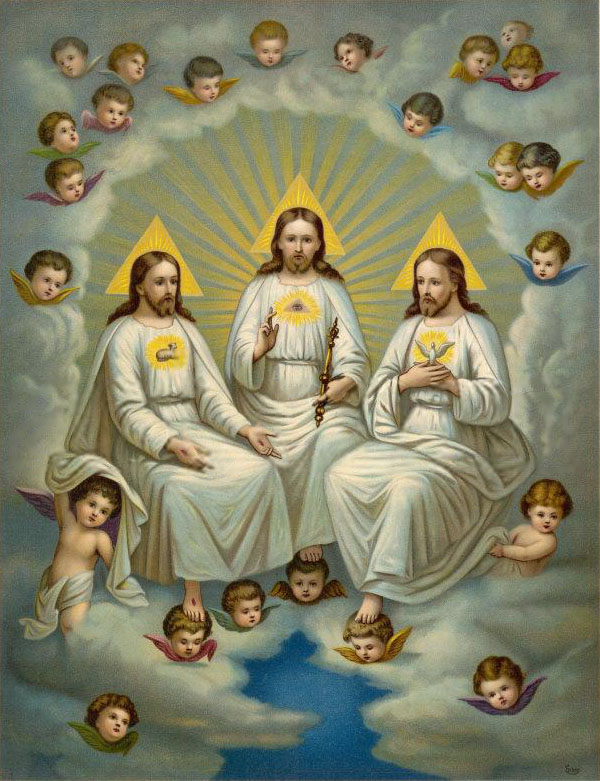
The Holy Trinity appearing to Alexander Svrisky

For there are three that bear record in heaven,
the Father,
the Word,
and the Holy Ghost:
and these three are one
1 John 5:7
(Comma Johanneum)


I have become interested in the Holy Trinity once again. Not by my own doing, however.

At Priestly Formation, we spoke a bit about the Trinity, which was interesting on a few levels; one being how some don't really care about it that much as a concept, another, I thought I understood it. I don't, really. We spoke of heresy, and it was mentioned that at a certain conference some priests were speaking abouty the Trinity and placing the position of the Spirit as higher than the Father and Son. I didn't really get why that would necessarily be heresy.

The previous day, I had placed this picture on my desktop at work.

Holy Trinity
Fridolin Leiber

When I returned after going up to Newcastle, I was informed by many on my choice of desktop picture:
It is Hindu.
It is hideous.
I suppose everyone likes different art.
It is heretical.

Why is it heretical?

It must be to do with the fact that all three persons are depicted as Jesus.

I preached on the Transfiguration on the following Wednesday. Afterwards, Fr Steven pointed out a part that may have been heretical:
At the Transfiguration, it wasn't Jesus changing into something, or becoming God
This is called subordination. I was placing the Son in a position lower than God.

So much learn, so much to learn.

Friday, August 1, 2008

"The three of you need to see something..."


Altar painting. Jalasjarvi, Finland

and he was transfigured before them:
and his face did shine as the sun,
and his garments became white as the light.

Matthew 17:2 RV

What am I really going on about with all this Transfiguration business? What is my main point?
What do I see as the relevance for our lives today? In our lives as Christians?

The first point is that the event, the actual
physical transformation is not of Jesus' doing. He does not transfigure himself: he is transfigured.

The second point is that he is transfigured
before them, the three pillars of the church, Peter , James, and John. (Gal 2:9) The event is for their sake, as much as his own. In fact, I believe the main reason for the event is to show them his true identity; that of the Son of God.

How does Jesus' Transfiguration show that he was the Son of God?If it was to occur as the first thing "the three" had experienced of Jesus, they would more than likely thought he was supernatural, but not necessarily the Christ. By this point in the Gospel, they have witnessed many things, heard revelations, and seen prophesies fulfilled. It is once Peter answers Jesus with "You are the Christ" (Matthew 16:16), once the point has been proven so to speak, that Jesus starts to explain how he must suffer, be killed, and rise again (Matthew 16:20-21). This is the fate of the Messiah? Confusion must have reigned amongst the disciples. Maybe this is why Judas betrayed Jesus. Not an act of malice, but an act of disbelief?

By these three men seeing Jesus face shine like the sun, they could not have had any trace of doubt of his true divine nature. I am not suggesting that this is the only reason this occured. I believe there are implications for us today, regarding prayer, meditation and and our own spiritual natures revealed on the mountain. Jesus revealed himself as he really was, and was also showing the ultimate reality or destination of those who follow him:
We know that,
if he shall be manifested,
we shall be like him;
1 John 3:3 RV

Thursday, July 31, 2008

"When I am in the world, I am the light of the world"

C 12th Icon from St. Catherine's Monastery, Sinai

and he was transfigured before them:
and his face did shine as the sun,
and his garments became white as the light.
Matthew 17:2 RV

Light is often used throughout the Bible to show God's presence.

When Moses was in communion with God on Mt Sinai,
the skin of his face shone by reason of his speaking with him.
Exodus 34:29 RV

And as Moses' radiant face gave a legitimacy to his experience, and his message. His face shone due to his communion with God, a reflection.

One can also read in the lives of the mystics, that when in communion with God, similar experiences occur: When St Teresa was writing The Interior Castle 'her face... shone with an unearthly splendour.'

On the other hand, Jesus face shone like the sun; it is the cause of the light, not a reflection. Jesus' radiance at the Transfiguration authenticates him as the new, and greater Moses.
God is light,
and in him is no darkness at all.
1 John 1:5 RV
He is revealed as he truly is, not being transformed into something new, or receiving some divine power; more it is a revealing of the heights of spirituality. As Bishop Westcott stated:
"The Transfiguration is the revelation of the potential spirituality of the earthly life in the highest outward form"
He goes on to state that Jesus in the Transfiguration:
"gives the measure of the capacity of humanity, and shews that to which He leads those who are united with him" The Historic Faith, p 256.
One can only wonder why the Transfiguration is so neglected in western Christianity.


Tuesday, July 29, 2008

Just more evidence for the brilliance of the 1928 Prayer Book


Last week at Priestly Formation, we were talking about the Prayer Book and its many revisions. I voiced my opinion for the brilliance of the 1928 version, and stated that I intend to use it (with a few lectionary changes) once I am in my own parish.

In the last week I have also been reading many bits and bobs about the Transfiguration. It seems that there was no special celebration within the Prayer Book until 1928, when it was given a collect and epistle reading, along with the relevant verses from the Gospel (Mark 9).

I was fully expecting to find the epistle to be from 2 Peter:
For we did not follow cunningly devised fables,
when we made known unto you the power and coming of our Lord Jesus Christ,
but we were eyewitnesses of his majesty.
For he received from God the Father honour and glory,
when there came such a voice to him from the excellent glory,
This is my beloved Son,
in whom I am well pleased:
and this voice we ourselves heard come out of heaven,
when we were with him in the holy mount.
And we have the word of prophecy made more sure;
whereunto ye do well that ye take heed,
as unto a lamp shining in a dark place,
until the day dawn,
and the day–star arise in your hearts:
2 Peter 1:16-19 RV

This is the epistle in the lectionary we use at church, the Revised Common Lectionary. It makes sense: a very clear reference to the actual event. The event, and Peter's eyewitness, is used as proof of Jesus' divine Sonship.

However, the BCP 1928 has the following:
Behold what manner of love the Father hath bestowed upon us,
that we should be called children of God:
and such we are.
For this cause the world knoweth us not,
because it knew him not.
Beloved, now are we children of God,
and it is not yet made manifest what we shall be.
We know that,
if he shall be manifested,
we shall be like him;
for we shall see him even as he is.
And every one that hath this hope set on him purifieth himself,
even as he is pure.
1 John 3:1-3 RV

On the outset, the former choice may be more appropriate. However, closer investigation reveals a greater
meaning:
we shall be like him; for we shall see him even as he is.
1 John 3:2 RV

At the Transfiguration, it wasn't Jesus changing into something, or becoming God; it is more like a veil was lifted, and he was revealed as he truly is: the Son of God.
As William Blake said:
If the doors of perception were cleansed every thing would appear to man as it is, infinite.
(The Marriage of Heaven and Hell, xxii)

Monday, July 14, 2008

Is 2008 the year of 1 John?

The following are my favourite parts of 1 John, if not the whole NT. These lines play in my mind, sink into my daily thoughts and actions, generally wander into my day.
God is light,
and in him is no darkness at all.
1 John 1:5 RV

We know that,
if he shall be manifested,
we shall be like him;
for we shall see him even as he is.
1 John 3:2 RV

He that loveth not knoweth not God;
for God is love.
1 John 4:8 RV

God is love;
and he that
remains in love
remains in God,
and God remains in him.
1 John 4:16 RV

And we know that the Son of God is come,
and hath given us an understanding,
that we know him that is true,
and we are in him that is true,
even in his Son Jesus Christ.
This is the true God,
and eternal life.
1 John 5:20 RV

The following is a pile of books that I have by my bed, then take back to my library, only to bring them back to my bedside. This has happened many times this year.

Westcott, Brooke Foss. The Epistles of St. John: The Greek Text, with Notes and Essays. London: Macmillan, 1883.
Law, Robert. The Test of Life: A Study of the First Epistle of John. Edinburgh: T.&T. Clark, 1909.
Findlay, George Gillanders. Fellowship in the Life Eternal: An Exposition of the Epistles of St. John. London & New York: Hodder & Stoughton, 1909.
Brooke, Alan England. A Critical and Exegetical Commentary on the Johannine Epistles. International Critical Commentary. New York: C. Scribner's Sons, 1912.
Gore, Charles. The Epistles of St. John. London: J. Murray, 1920.
Howard, Wilbert Francis. Christianity according to St. John. London: Duckworth, 1943.
Dodd, C. H. The Johannine Epistles. Moffat NT Commentary, 19. London, Hodder & Stoughton; New York:1946.
Lee, Edwin Kenneth. The Religious Thought of St. John. London: SPCK, 1962.
Brown, Raymond E. The Epistles of John. Anchor Bible, 30. Garden City, NY: Doubleday, 1982.

If last year was the year I (think) I really got the Christian idea, and further, the Gospel of John; this year is 1 John in waves and shimmers.

Wednesday, June 4, 2008

It's all about abiding


He that eateth my flesh
and drinketh my blood
abideth in me,
and I in him.
John 6:56 RV


I had a terrible weekend. I need not go into details, but it was dreadful (Let's say St John's Wort stopped working)

To be fair, things have been on a gradual decline for the past few weeks, including where I am within my spiritual development.

I believe questioning one's faith is vital for development. However, I have been feeling somewhat detached from it all of late: church, spirit, word; the whole lot.

Anyway, on Sunday, I went to Mass in my grim state and found the whole thing flat and difficult. When saying the Creed, I heard myself mumbling what I believed, but they were words; not beliefs. When it came to recieving Communion I could not look my Priest in the eye to receive the bread. Nor the Chalice assistant.
Walking back to my pew, I was relieved.

When I knelt to pray, I was overwhelmed. Tears streamed down my face. I could feel them running down my neck. My body was shaking, my mouth quivering. It was very real and uncontrollable. Then there was a slight brief taste of blood.
I felt relaxed and relieved, and was wondering why I had felt so bad. When I stood up to leave, I saw my tear splatters on the wooden floor. In embarrassment, I left without saying anything to anyone.

This experience reminded me of the reality of my faith. Wherever my head is, no matter how bleak, or "rational" or mystical, God is there. Not as an idea, or a concept, or something to question; but as an undeniable presence that goes beyond thought.

God is love;
and he that abideth in love
abideth in God,
and God abideth in him.
1 John 4:16 RV

Tuesday, May 20, 2008

Spirit, delivered by Service


A month ago, I was reading two books:
Lee, The Religious Thought of St. John. (1962)
Howard, Christianity according to St. John. (1943)

I found a quote that I liked, but I didn't have any paper to mark it, or write it down.
It was so good and spot on, and relevant, there was no possible way I was going to forget it.

I forgot what it was. I had read on into other subject matter, and.....
I would look through and find it.
However, because of the two books having a similar subject and layout, finding it was somewhat of a random search.

"man is not a pure spirit,
and that to have full effect,
spiritual teaching must be combined with the visible and material"
Gardner, The Ephesian Gospel, 1915, p. 210
quoted in:
Lee, The Religious Thought of St. John, 1962

I think this means that man needs symbolism (liturgy) and physical (Eucharist) to gain a full understanding of Christianity, or more succinctly in the words of Richard Hooker:
a sacrament is "an outward and visible sign of an inward and spiritual grace."

More recently been thinking about mysticism and spiritual development. I believe that any form of true higher spiritual experience is either meaningless, or impossible without a large element of service. Christianity's humanitarianism is also part of it's way toward God, by the example of Jesus.

We know that,
if he shall be manifested,
we shall be like him;
for we shall see him even as he is.
1 John 3:2 RV