Pages

Showing posts with label NT: Gospel of Matthew. Show all posts

Sunday, November 23, 2014

Sermon for Christ the King


“Truly I tell you,
just as you did it to one of the least of these who are members of my family, 
you did it to me.”

‘When the Son of Man comes in his glory, and all the angels with him,
then he will sit on the throne of his glory.
All the nations will be gathered before him,
and he will separate people one from another
as a shepherd separates the sheep from the goats, 

We are at the judgement.
Jesus sits on a throne in glory, angels around him.

This must will be wonderful sight, one we will all behold, one we will all share in.
Christ the King,

All the nations will be gathered before him,
and he will separate people one from another
as a shepherd separates the sheep from the goats.

It gets a bit trickier there.
This idea of separation.
Sheep and goats.

It all seems quite harsh.
But I suppose the good thing is that in the passage, we are given the criteria of this judgement.
In this passage, Jesus tells what it is that we are to be judged on.
And with the overall message of Matthew’s Gospel,
we are given a lens with which we can focus the message

Jesus says to the those at his right hand, the sheep:

“Come, you that are blessed by my Father,
inherit the kingdom prepared for you from the foundation of the world;
for I was hungry and you gave me food,
I was thirsty and you gave me something to drink,
I was a stranger and you welcomed me,
I was naked and you gave me clothing,
I was sick and you took care of me,
I was in prison and you visited me.” 

This list is more or less repeated four times in this passage.

Hungry, thirsty, stranger, naked, sick, imprisoned.

Listen to those.

Hungry, thirsty, stranger, naked, sick, imprisoned.

Think of the kind of people that will suffer them.
These are the people who are having it really tough.
Some may have made bad decisions that have led them to be in such a situation.
But I don’t hear anything in what Jesus says that would allow that to be a reason to not help.

Food, water, welcomed, clothed, care, visited.

Listen to those.

Think of the kind of person that would respond to those in trouble in such a way.
This is a person who responds to need.

Think of the kind of heart that responds in such a way.

This is a heart that is open to another.
This is a heart that is not hardened by life.
This is a heart that is not cynical or suspicious.
This is a heart that responds openly with love.

The actual acts, the actual needs are not the important element.
They are repeated to emphasize the idea of need,
to really bring home the hopelessness of some people’s lives,
but in and of themselves they are not the point.

The main point is what is going on in the person who responds.

It is about showing mercy.

Mercy is a strong feature in Matthew’s Gospel.

In the calling of Matthew,
when Jesus is being criticized for associating with tax collectors and sinners, he replies
Go and learn what this means, “I desire mercy, not sacrifice.”

Again, when he is criticized for doing something unlawful on the Sabbath, he replies
But if you had known what this means,
“I desire mercy and not sacrifice”, you would not have condemned the guiltless.

I desire mercy and not sacrifice

In both instances Jesus is quoting the Prophet Hosea
For I desire steadfast love and not sacrifice,
   the knowledge of God rather than burnt-offerings. 

Steadfast love, mercy.

This is more important to God than anything else.
To do the works,
to clothe, feed, visit, and care,
but without a heart that is filled with steadfast love,
to do such works as these without a heart that is acting out of mercy
is to miss the point.

It is mercy that God desires from us.

He longs for us to not only look after those who are doing it tough,
but more so to join them in their pain and suffering,
to be one with them, hearts joined, their pain is our pain.

At the outset of his ministry,
Jesus laid out his manifesto of sorts, in which he said:
‘Blessed are the merciful, for they will receive mercy.

He says to those who have shown such mercy
Come, you that are blessed by my Father,
inherit the kingdom prepared for you from the foundation of the world

Mercy, true heartfelt, at one with others mercy will receive mercy from him.

But this goes even deeper that just judgement.

Look who is speaking.
Look at who is being fed, clothed and cared for.

It is Jesus.

“Truly I tell you,
just as you did it to one of the least of these who are members of my family,
you did it to me.” 

So, on this feast of Christ the King, when we celebrate the exalted Lord,
we are to remember Christ as one of the least.

And think of Jesus words when questioned about the greatest commandment:

“You shall love the Lord your God with all your heart, and with all your soul, and with all your mind.” This is the greatest and first commandment. And a second is like it: “You shall love your neighbour as yourself.” 

With Jesus self identification with the least, our neighbour, this statement becomes deeper.

In loving and serving our neighbour, we are loving and serving Christ.

The two commandments have become one and the same.

‘Blessed are the merciful, for they will receive mercy.

It will be in our showing mercy, that we will receive mercy

Sunday, November 9, 2014

Sermon for the Twenty Second Sunday after Pentecost


Keep awake therefore, for you know neither the day nor the hour.

When I hear of the second coming of Jesus, I think of a few things. 
In my prechristian days, I think I heard about this more than anything. 
I’d see pictures of people with sandwich boards proclaiming “The day is near” or something. 
I thought they were mad. 
To this day, when people carry on about Jesus return, 
I still think they are a bit unbalanced. 

It also reminds me of the Jesus people movement of the 1970s. 
Much of the music that was recorded at that time speaks of Jesus return. 
Nearly every album by these artists will contain a song about Jesus return. 
The two texts that the hippy Christians really responded to were Revelation and the reading we had from 1 Thessalonians today:

For the Lord himself,
with a cry of command, with the archangel’s call and with the sound of God’s trumpet, will descend from heaven, and the dead in Christ will rise first.
Then we who are alive, who are left,
will be caught up in the clouds together with them to meet the Lord in the air;
and so we will be with the Lord for ever. 

It is true, we do need to consider this. 
It is something we all believe: 
we say it together in the Creed, 
we acclaim it in the Eucharist, 
so this is not something foreign or wrong. 
It is though, an issue of emphasis. 

The problem is that this has been used as a way of control and keeping people in a state of fear. 
Fear is the best way to control people, as governments past and present know full well. 
Life with Christ should not be based on fear. 
It should be based on love:
Love of God and love of neighbour.

So what is Jesus getting at with this parable about the ten maidens.
We can look at all the details, 
we can question whether the 5 wise ones should have given the oil to the 5 foolish ones. 
We can ask what does that mean for us? 
Should we not share our oil with those who have none? 
Are we to look out for ourselves and not worry about those who can’t, 
for what ever reason?

All that is is to miss the main point:

Keep awake therefore, for you know neither the day nor the hour.

Keep awake.
Be ready.
Be prepared.
I was a scout. Be prepared was the motto. 
I can’t exactly remember what that meant as a scout, but it has stayed with me.

There will be items that you will always have with you. 
Wallet, phone, whatever. 
You know the things you need to have with you so you can do whatever it is you need to do, 
and if there something you might have to do.

It is those ‘just in case’ things though. 

Back home, there was a rule: always take a coat. 
You never knew how cold it was going to get, or how long you were going to be.

These days, there are several things I do to always be prepared. 
There are items I always carry with me: 
  • the Scriptures, 
  • the Prayer Book, 
  • Reserved Sacrament, 
  • Oil of the Infirm, 
  • a Stole. 

These are always in  my bag, wherever I go. 
So whatever situation I am called into, I have what I need.

These are practical things.

We keep our houses tidy in case someone pops around.
We check how much petrol we have before we go on a long drive.
Basic stuff.
We are now being told to get our bushfire plans in place. 
Be prepared.
Jesus is telling us the same thing, but on a much more serious scale. 
And even more so, he is talking about a constant state of readiness. 

Keep awake.

What does that really entail for us.
What is our state of preparedness?

I think one of the key issues is that this can’t be based out of fear.

If we only do good because we are scared of being punished, 
because we are scared of not going to heaven, 
then we are missing the point. 

Keeping awake is important for its own sake.
Being prepared is being awake to God. 

By being awake to others around us, 
we are awake to what God is doing in and around our lives. 
By being awake our hearts are opened to know the pain in other peoples lives, 
to see where God is present to begin his healing work. 
When we are truly awake, we understand that it is through us that this work is done.

When we are awake, we are prepared. 
We are prepared to see Christ among us, in us, and with us. 

We are awake and prepared when we live our lives loving God and loving our neighbour as ourselves

By keeping awake, we are not only ready to see Jesus when he returns,  
but also our true selves are awoken to know his presence in every moment of our lives. 

We are awoken to the eternal presence of God.


Sunday, January 27, 2013

Jesus did this, the first of his signs, in Cana of Galilee, and revealed his glory; and his disciples believed in him


Jesus did this, the first of his signs, in Cana of Galilee, and revealed his glory; and his disciples believed in him.


When my sister and brother in law were planning their wedding a few years back, they were given a selection of readings to choose from, one of which was this passage we have just heard. As I was the churchy one in the family, my opinion was asked. I strongly suggested using this passage.

“Why?” I was asked.

“Well, it is about a wedding. I really like it.” Not the most convincing argument.

“But what about what Jesus says to Mary?”

Woman, what concern is that to you and to me?

“I can’t have that at my wedding! It is just rude!”

So, the choice ended up being the reading from 1st Corinthians. And in all honesty, Paul’s words about love have much more to do with a wedding than this passage today. You see, this passage has very little to do with marriage at all. The wedding is place where something far more significant is happening. As John states:

Jesus did this, the first of his signs, in Cana of Galilee, and revealed his glory; and his disciples believed in him

So, what actually happened?

Jesus and his followers, which probably add up to seven at this point arrive at a wedding, and the wine has run out.  Jesus changes the water into wine.

It could be that he was having a great time and wanted the party to continue, but that would hardly be a reason for his disciples to believe in him.

Jesus uses this crisis in the celebration to show those with eyes to see who he really is, to reveal his divinity.
Now standing there were six stone water jars for the Jewish rites of purification, each holding twenty or thirty gallons

There are six jars which will be used at the end of the celebration for purification rites. The water would be used to wash the bride and bridegroom and all the guests. But Jesus uses these jars and water and changes them to wine.

By using these jars Jesus is showing that these rites are no longer necessary. By the presence of the incarnate Lord, the old way of being and doing will change.  The water of purification was a way of keeping people in and out of God’s presence. But with God being present in the person of Christ there is no issue of who is in or out. The water of the Old Testament is turned into wine.

It is significant that Jesus uses something from the old way to reveal his Glory. He doesn’t remove the water, he changes it.

As he says in Matthews Gospel:

Do not think that I have come to abolish the law or the prophets; I have come not to abolish but to fulfil. For truly I tell you, until heaven and earth pass away, not one letter, not one stroke of a letter, will pass from the law until all is accomplished.
Mat 5:17-18

Jesus shows that the old way was not complete. His changing the water to wine is fulfilling the old for it to become the new.

And it is no ordinary wine
           
But you have kept the good wine until now

The steward says. Wine could not be this good before the incarnation. Jesus fulfils the old, and his presence on earth means that even something like wine fulfils its abilities.

We will see this again at the multiplication of the loaves. The stories are very similar. Both arise out of a crisis involving the sustenance of a crowd that has gathered. In the story of the loaves, Jesus uses a small amount of bread that is provided and multiplies it to feed the many that are there. Here with the wedding, he uses the water for purification and changes it to wine for the guests.  With the bread, the comparison is made with the old way:

Our ancestors ate the manna in the wilderness; as it is written, 'He gave them bread from heaven to eat.'" Then Jesus said to them, "Very truly, I tell you, it was not Moses who gave you the bread from heaven, but it is my Father who gives you the true bread from heaven. For the bread of God is that which comes down from heaven and gives life to the world."
John 6:31-33


In both stories the sign that is shown is that Jesus is the Son of God, and not only that, but that what he does fulfils the old. In both stories the comparison is made with the old system and how things are now different.

But what are we to make of Jesus “woman” comment:


"Woman, what concern is that to you and to me? My hour has not yet come."


It is not a rebuff really. Mary appears only one other time in John’s Gospel, at the foot of the cross. Here again Jesus will call her “woman”

When Jesus saw his mother and the disciple whom he loved standing beside her, he said to his mother, "Woman, here is your son."
John 19:26


But the difference here as opposed to the wedding, is that his hour has come.

Jesus changing of the water into wine heralds the shedding of his blood on the cross.

And at the last supper, Jesus will speak of the union of suffering and glory that he will experience in his death and resurrection. This is shown in the changing of water and the wine. The old way of thinking what the messiah will be has been changed to a new understanding.

Jesus did this, the first of his signs, in Cana of Galilee, and revealed his glory; and his disciples believed in him.
John 2:1-11

Monday, November 19, 2012

Homily for Pentecost 25


Tell us, when will this be, and what will be the sign that all these things are about to be accomplished? 


Israel assassinates the military commander of Hamas.
The Palestinians send bombs into Tel Aviv and then Jerusalem.
Over 150 Palestinians are killed by Israeli attacks on Hamas targets.
Israel calls up 70000 reservists ready for a ground assault on Gaza.

That same day there are mass strikes and protests in Europe.
Workers and union leaders call for everyone to stop work in protest of new austerity measures.
Police and the army arrest 100s in Portugal, Spain, and Greece.
In Spain unemployment has reached 25 %.

In these same days, there is a solar eclipse.
The sky is darkened, and the sun gives of no light,
other than a bright haunting ring that blinds those who dare look at it.

Earlier in the month there is a hurricane in the east coast of the US and Cuba.
Hundreds die, hundreds of thousands are left homeless.
Those with homes have no power.
Looting takes place, there is no food in the shops, there is lawlessness.
People are scared and hungry.


When you hear of wars and rumours of wars, do not be alarmed;
this must take place, but the end is still to come. 
For nation will rise against nation, and kingdom against kingdom; 

Some see our time as the end times.

Some seem to gain much comfort from the fact that the period they are living in God has chosen to be the final stage of humanity.
This is where Christ will return, and all the redeemed of the earth will be raptured.
Many take comfort from the fact that those who disagree with such ideas willing fact be left behind.

These ideas started way before Jesus, as we heard from the book of Daniel earlier:

At that time Michael,
the great prince,
the protector of your people,
shall arise.
There shall be a time of anguish,
such as has never occurred since nations first came into existence.

In Daniel’s understanding, the archangel Michael will rise and protect the people of Israel.

Jesus doesn’t really talk about the end times. He talks about some things that must happen before the end times can occur.

When you hear of wars and rumours of wars, do not be alarmed;
this must take place, but the end is still to come.
For nation will rise against nation, and kingdom against kingdom; 

Since Jesus time, there has rarely been a time of peace. There have been periods where there has been less conflict, or conflict on a smaller scale, but always some conflict. Our own time is one of the worst for international war.

This is but the beginning of the birth pangs. 

The disciples ask when the end times will occur.
Jesus answers later:

But about that day or hour no one knows,
neither the angels in heaven, nor the Son,
but only the Father. 

Not even Archangel Michael, who Daniel informs us, will be the precursor knows when these things are to occur.

The conflict in Gaza and Israel, the strikes and economic woes of Europe, the hurricane in the US and the solar eclipse aren’t signs of the end times. Jesus warned against predicting such things. He in fact taught the opposite:

do not worry about tomorrow, for tomorrow will bring worries of its own.
Today's trouble is enough for today. 

Be present to what is happening.
Being present and like Christ is being aware, being ready to help, noticing and acting upon injustice and suffering.

The way of Christ is to renounce all violence in the Israel and Gaza, not to take sides, to unmask the cause of the violence.  It is to make sure those who are injured are healed and those who are hungry are fed.

The way of Christ is to fed, clothe and home those who have suffered through the hurricane.

It is natural to worry about the future.
We all want to know what is going to happen.
But Jesus reminds us to be present to where and when we are:

do not worry about tomorrow, for tomorrow will bring worries of its own.
Today's trouble is enough for today. 

Look at what is happening around us, not in some way to predict the future, but to be truly present to what is actually happening. Be present like Christ was present to the suffering he witnessed

It is by being present to what is occurring that we can be like Christ: helping, healing, teaching, showing the light and love of God to all we meet.

Instead of trying to work out when the end is to happen, Jesus tells us to present to the suffering and anguish that is around us, in our present time.

Do not worry about tomorrow, for tomorrow will bring worries of its own.
Today's trouble is enough for today. 

But about that day or hour no one knows,
neither the angels in heaven, nor the Son,
but only the Father. 


Wednesday, January 4, 2012

Homily for Epiphany


“we observed his star at its rising, and have come to pay him homage.”

The story of these magi is most likely the most popular Christian story that there is. This is a story that people, and most especially, people that aren’t church goers, really relate to. Three wise men on camels carrying gifts. For many, this is the symbol of Christmas.

Driving around Singleton this last fortnight to look at all the houses decorated with Christmas lights, I noticed that the three wise men and the star would only be second to father Christmas and Reindeer. Why these magi? Why not the shepherds? Why not the angels? Why not the infant Jesus?

 I think it is because of their very mysteriousness, but also it is the undeniable and intrinsic truth of their story.

The first we hear of them, they have arrived in Jerusalem, asking anyone who would listen:

"Where is the child who has been born king of the Jews?"

I imagine that many of those they asked had no idea what they were talking about. They hadn’t heard anything about a birth that was so special. But then the magi state how they know this information:

“For we observed his star at its rising, and have come to pay him homage."

Someone must have heard this and thought it important that King Herod knew about these foreigners wandering around hunting for the new born king of the Jews.

Herod is worried. He knows this is not good news for his rule. A divine ruler, the Messiah is going usurp any authority he has. He sees his days numbered.

He calls the chief priests and scribes to find out where this child is to be born. He needs the answer to the magi’s initial question:
"Where is the child who has been born king of the Jews?"

He asks the scribes and priests. They know their scriptures well. From prophecies in the books of 2nd Samuel and the prophet Micah, they can name the town of Bethlehem as the place.

What we can see here is God’s revelation to two groups of people in two different ways.

The Magi were Gentiles, non Jews. Gentiles were deprived of the scriptures, and so they were not given an explicit revelation as the Jews were. It was through nature that God revealed himself to the gentiles.

The magi receive their revelation through the stars. Their gazing and interpretation of the movement of the stars showed them something significant was happening Israel. They interpret the movement as being a birth star. So significant is the star and its movement, they deduce that it must be represent a King. They didn’t have the scriptures to work this out. It was their astrological gifts that showed them.

Yet, it was an imperfect revelation. It tells them of the birth, but not exactly where.

That secret is locked up in the scriptures.

Those who have the key to the scriptures, the scribes and high priests are unaware that anything is happening. They can read plainly what the prophets have said. They know the Messiah is to be born in Bethlehem. Now they have a group of magi arriving, who have followed a star for probably two years, arrive and tell them they know the King of the Jews has been born. 

Both groups have a piece of the puzzle.

Yet only one group thinks it is worthwhile. The religious and political leaders do nothing. They don’t follow the Magi to worship the new born king. In fact the king, the chief priests, and the scribes conspire against the messiah. They play no part active part in Jesus birth story. They just sit there. They know where the Christ is to be born, but they don’t sense what is actually happening, or ask the magi anything about what they know. They fail by being passive.

The other group, who represent the Gentiles, the magi, see a sign and journeys far to respond to the hint of Gods action in history.

When I look at this manger, when I see the infant Jesus lying there, I wonder what group I am in. I wonder what group our church is in. I wonder what group the whole worldwide church is in.

We are not the magi. The magi represent the journey from the first inklings of something to recognition, to homage. That is what they are. Once that journey has taken place, something else occurs. They become members of the Body of Christ.

The infant body in the manger grew up, lived, taught and healed, was crucified, died, rose again, and ascended into heaven. But we are now the body of Christ. We say this every week. We are the mystical body of Christ, the same way that the baby in the manger was the body of Christ.

So we are neither group, we are the body of Christ.

I think the sad truth is that we the church sometimes forget that we are the body. We in many ways have become like the scribes and high priests and political rulers.

The magi are still around, they see signs of God in their lives, they interpret things they hear and see as God working in their lives. They may come to church to pay homage to the infant, they come to be a part of the body of Christ, yet when they arrive and tell of what they have seen and experienced, instead of meeting the body of Christ, they meet a bunch of scribes and high priests who either ignore them, or tell them that they know nothing.

These magi know nothing of the scriptures, yet they know there is something going on. They see our buildings and know there is something beyond everyday experience inside. They come to find Christ, but they don’t really know anything about him.

I see a time when these magi will come to our church and tell us things about Christ that we don’t understand. They will have found Him working in their lives, yet won’t know anything of scripture. They will come with voices and visions that will look and sound peculiar to us. They will tell us things that we may not want to hear.

When this happens we can’t be like the scribes and high priests and ignore them. We need to listen. We need to help them with our knowledge of the scripture and journey with them as they journey to us.

What they are searching for is the body of Christ. They instinctively know they want to be a part of it. They enter our churches and become confused or depressed because they know what it is supposed be like, yet what they encounter is nothing like it. There are glimpses of Christ for them, but it is hidden away, like the scriptures were hidden from the Magi in the gospel.

I believe that the situation the church finds itself in today is like holding one half of the puzzle.

We have the scripture, the sacraments and the traditions. We hold them as members of the body. Yet, they have become hidden from magi of today. It is those magi who have the other half of the puzzle.

We will find the other part of the puzzle when we listen to their stories of how God revealed himself to them. It will be in our listening to their stories of their spirituality that we will see how God is working in places outside of our traditions. By us sharing our stories with them, they will see how God is working within the church, within the body of Christ. To be able to reveal Christ to the magi, we need to be able to see where he is already being revealed. We can show the magi where Christ is in their lives.

This is why I think the magi from Matthew's gospel are so popular in the wider world. People who aren’t church goers somehow see themselves within the image of the magi, making their journey towards Christ. Like the Magi, they journey long distances, knowing something of God, yet not knowing exactly where He is. It is when the star that they are following stops above our church that we need to be the body of Christ and not act like the scribes and high priests. Instead of being passive and dismissive, we need to journey alongside them and lead them to the manger, to the body of Christ.

Friday, May 22, 2009

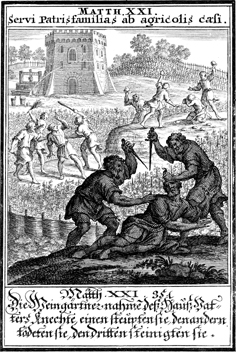
The Parable of the Wicked Tenants


Here is another essay that has been causing me grief.
Jesus teaching with Parables consists of using the unknown with known, the strange with familiar.[1] The parable of the Wicked Husbandmen is unique among the parables of Jesus due to it essentially being an allegory. Here the vineyard is Israel, the landowner is God, the slaves are the prophets, the tenants are the religious leaders of the time, and the son is Jesus Christ. But this is really only half the story. It is the way that this allegory is used within a realistic context that makes it so powerful.

In Isaiah 5:7 the House of  Israel is represented as a vineyard. This use of Isaiah  shows the reference  to the vineyard and the owner are not to be understood as “earthly”, but representations of Israel and God.[2] All three synoptists use this allegory. Matthew and Mark add imagery from Isaiah 5:1-2: the setting of a hedge, the digging of a winepress, and the building of a tower. Luke omits this clear allusion to Isaiah, but his readers would still have understood the general reference of the vineyard.[3] The planting and care of a vineyard are signs of a prudent householder.[4]

At this time in Palestine and Galilee, many landowners were absentees.[5] This gives the parable a sense of reality, as there was unrest due to landlords living elsewhere[6] Luke adds to this “for a long time,” to emphasize the amount of responsibilty given to the tenants, to state they were trusted.[7] It is the owner’s absence rather than his departure that is illustrated in the parable. The God of Israel is being represented as an absentee landlord. [8] The absence represents the distance between God and the religious leaders of the time, due to their own withdrawal.[9] His absence is in actuality theirs. He had not forgotten them; he will send his slaves, and his only son.[10]


In Mark and Luke, the slaves are sent “in season”.  Due to the winepress being mentioned, this would be the time of winemaking, not the actual harvest as is stated in Matthew.[11] Either way the slaves are sent at appropriate times in history of salvation.[12] The sending of slaves refers to the sending of prophets.[13] The slaves are arranged and treated differently in each version. In Matthew, the slaves are sent in two groups; this may represent the former and latter prophets.[14] In Mark they are sent as individuals to portray the distinctive message of each prophet.[15] In Luke a single slave is sent each time, the violence each time escalating, climaxing in the killing of son.[16] Whether the next messengers are sent in the same season or the next is not stated, but the central point is that the trouble does not start straight away. Not only are the husbandmen given several opportunities to pay their rent, the message to do so is delivered in differing ways by different people.[17]

By using the same nomenclature as was used at both Jesus’ baptism and transfiguration, “beloved son” alludes to a christological interest.[18] The sending of the son is not only theological; it follows the logic of the story.[19] The owner expects his son will be well received. The arrival of son allows the tenants to think the owner has died.[20] Earlier it had been just slaves who had been sent who had no personal interest in estate. The one and only son is sharply contrasted with many slaves.

This is stated elsewhere in the New Testament:[21]
Long ago God spoke to our ancestors in many and various ways by the prophets, but in these last days he has spoken to us by a Son, whom he appointed heir of all things.
Hebrews 1:1-2 (NRSV)

The owner represents God by showing mercy and being long suffering.[22] By pursuing the contractual arrangements to end, he shows Gods fidelity.[23]

In Matthew and Luke, the son is thrown outside, and then killed.[24] This is similar to the Passion story in Matthew, where Jesus is crucified outside the city.[25] This analogy is awkward, as the vineyard represents Israel, not Jerusalem.[26] In Mark, the body cast out unburied as a final insult.[27]


To understand parable it is essential that the owner is living away. By removing the sole heir, the tenants can take unhindered possession. The law states that under specific circumstances an inheritance may be regarded as ownerless property, which may be claimed by any one, with the proviso that the priority right belongs to the claimant who comes first. [28]

At this point in the parable, Jesus uses a quote from Psalm 118.  Jesus’ view of the Old Testament was very spiritual, he felt it transcended his own age. He would have seen in Psalm 118 not a direct reference to himself, but only “the statement of a principle applicable to himself.” [29]

Psalm 118 was one of the primitive church’s proof texts for the resurrection and exaltation of rejection of Christ.[30] The whole of psalm 118 is a vindication of Gods purpose. This final week of Jesus’ earthly ministry is to be seen in the light of Gods victory snatched from defeat, God’s selection of his own people, and the new Kingdom of God, in gathering of the elect into Father.

The cornerstone referred to is the head of the corner, the stone used in buildings corner to bear stress and weight of the two walls; it is crucial to whole structure. It is this elevation of rejected stone into its predestined place at the head of the corner in which the Psalmist see the hand of God.[31] 

This rejected stone will become a stumbling block, as stated in Isaiah:

He will become a sanctuary, a stone one strikes against; for both houses of Israel he will become a rock one stumbles over—a trap and a snare for the inhabitants of Jerusalem. And many among them shall stumble; they shall fall and be broken; they shall be snared and taken.
Isaiah  8:14-15 NRSV
The stone of offence is God, a refuge and sanctuary to those who trust in Him, a snare to the faithless. This speaks of the refusal of Israel’s leaders to put their trust and confidence in God’s will.[32]
A chief cornerstone would not be likely to trip or fall on a person.[33] Christ will be a stumbling block for some, and they will suffer heavily for their shortsightedness.


In between the quote from Psalm 118, and the clear reference to Isaiah 8:14-15, Matthew adds the following:

Therefore I tell you,
the kingdom of God
will be taken away from you
and given to a people
that produces the fruits of the kingdom. 
Matthew 21:43 NRSV

In Matthew alone is the Vineyard referred to as the kingdom of God. [34] The kingdom is not only of future, the vineyard is underdeveloped, because it has been in possession of those who were unworthy. Vineyard in wrong hands will not bear fruit. No nation or people will have a permanent right to the vineyard.
Because the rulers will kill the Messiah, the vineyard, the Kingdom of God will be taken from them. It will be given to others.[35] The vineyard should be given to all, not one nation. [36] The “Israel of future” will be advanced to honour by the death of the only son. A judgement on Israel’s rulers is a conclusion that is impossible to resist, and also reflects tensions between Jew and Gentile.[37] Owner will come to sort it out.[38]


While the parable of the Wicked Husbandmen may be a very lofty allegory, it is its realism that makes it so tangible. It is a resemblance to a social reality. First, it has a strong resemblance to social reality. The fact that there was unrest in Palestine and Galilee due to landlords living elsewhere,[39] starts the parable off in a realist way. Another element Jesus audience would have understood was that the “payment in kind” which the tenants were to pay the landowner had led to many disputes with dishonest tenants who had leases.[40] None of this is really unusual for Jesus’ teaching; he was always vindicating the poor, the despised and alienated.  Here the tenants have opposed and rebelled against God. The rulers will be dispossessed. They will not only lose the blessing offered, but what they reject will actually cause their overthrow.

Bibliography

Albright, W.F.; Matthew (1986) Doubleday: New York

Allen, Willoughby C.; A Critical and Exegetical Commentary on the Gospel according to St. Matthew (19??) Edinburgh: T. & T. Clark

Creed, J.M.; The Gospel according to St. Luke (1930) MacMillan: London

Dodd, C.H.; The Parables of the Kingdom (1961) Fontana: London

Dormanday, Richard; “Hebrews 1:1-2 and the parable of the wicked husbandmen” in The Expository Times (Vol 100. No. 10; July 1989) pp. 371-375

Fitzmyer, Joseph A.; Luke (1985) Doubleday: New York

Gould, Ezra P.; A Critical and Exegetical Commentary on the Gospel according to St. Mark (1921) Edinburgh: T. & T. Clark

Inge, W.R.; The Gate of Life (1935) Longmans, Green and Co: London

Jeremias, Joachim; The Parables of Jesus (1963) SCM Press: London

McNeile, Alan Hugh; The Gospel According to St. Matthew (1957) MacMillan: London

Mann, C.S.; Mark (1986) Doubleday: New York

Oesterley, W.O.E.; The Gospel Parables in the Light of their Jewish Background (1936) SPCK: London

Plummer, Alfred; A Critical and Exegetical Commentary on the Gospel according to St. Luke (19??) Edinburgh: T. & T. Clark

Swete, Henry Barclay; The Parables of the Kingdom (1920) MacMillan: London

Swete, Henry Barclay; The Gospel according to St. Mark (1909) MacMillan: London